I'm a commercial lighting buyer. I've been handling lighting orders for eight years, and in that time I've personally made (and documented) ten significant mistakes, totaling roughly $31,000 in wasted budget. Now I maintain our team's lighting replacement checklist. This article is the part that never makes it onto a quotation.
I still kick myself for my first big one. In 2017, I approved a chandelier replacement for a small hotel lobby. The fixture looked perfect in the showroom. It arrived on time. It did not fit the existing junction box. The mounting plate was four inches too narrow, the canopy hid nothing, and an electrician had to build a custom adapter on-site. Eighteen pieces, $2,100 in rework, one very unhappy general contractor.
From the outside, replacing a chandelier looks like the easiest lighting project on the list. Turn off the breaker, disconnect three wires, unbolt the old fixture, reverse the process. The reality is that a chandelier—especially a chandelier large enough to define a lobby—is not a fixture. It's a system. When you replace a system with a fixture, you're going to pay for the difference.
The Surface Problem: It Looks Like a Swap
Most buyers focus on three things: size, finish, and price. I understand. Those are the things that show up in photos and in front of clients. But a large chandelier is also a structural load, an electrical device, a heat-management problem, and a light-distribution tool. The finish is the last thing that fails.
Here's the thing: a commercial ceiling is not designed for 'one chandelier.' It's designed for a specific junction box, a specific circuit, and a specific support path. If the new fixture weighs more, the support path needs to be re-engineered. If it weighs less, the old support path might be fine—but the new canopy might not cover the old mounting holes. No amount of polishing fixes that.
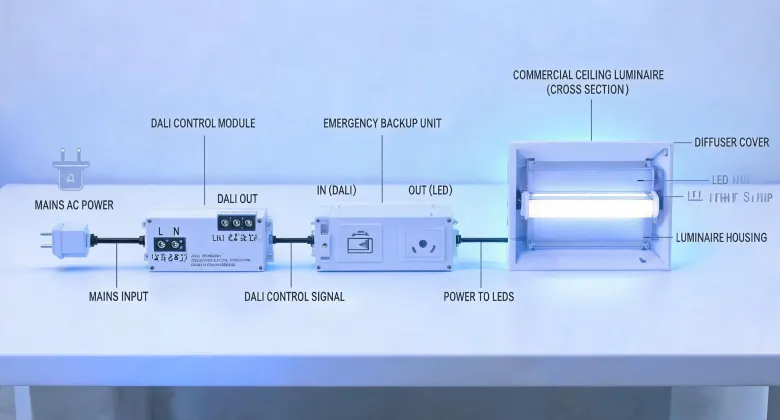
People assume that a newer LED fixture will be simpler than the old incandescent monster. Sometimes it is. But LED fixtures bring their own questions: where does the driver go, what voltage does it need, can the dimmer handle the driver, and what happens if the driver can't breathe? Those questions aren't optional. They're the difference between a five-year fixture and a one-year headache.
The Deeper Problem: You're Not Buying a Fixture, You're Buying a System
The question everyone asks is, 'How much light does it put out?' The question they should ask is, 'How does the light leave the fixture?'
You can make a chandelier with 48 LED modules bright enough to light a lobby. But if the optics send all the light down, the ceiling goes dark and the room feels like a cave. You end up adding more fixtures to compensate, which defeats the whole point of a statement piece. That's why I ask for photometric files before I ask for a price.
And this is where Samsung LED lights changed how I work. It's not magic, and I'm not going to claim they're perfect for every room. But their spec sheets include LM-80 data, IES files, and driver compatibility details. That might sound boring until you're standing on a lift at 30 feet with a driver that doesn't match the dimmer.
If you've ever seen a Samsung smart TV LED screen handle a bright window without turning half the image gray, you have a rough idea of how Samsung thinks about color and brightness consistency. The same attention to binning shows up in their LED components. When a chandelier has 60 separate light sources, you need that consistency. Otherwise, at 10% dimming, you get a rainbow of whites.
The Cost of Guessing: A Real Page From My Ledger
In September 2022, I specified a replacement chandelier for a restaurant renovation. I checked the diameter, the finish, the number of lamps, and the delivery date. I did not check the voltage.
The new fixture was built for 208V. The building's lighting circuits ran at 277V. It looked fine in the spec sheet—on my screen, anyway. On-site, the drivers started shutting down after 45 minutes. 54 LED modules, $3,400 in replacement drivers, plus a crane rental and a one-week delay. That error cost more than the fixture's markup.
The worst part wasn't the money. It was a small restaurant owner who asked me a question I should have asked myself: 'Did you look at the drivers?' That client had a $2,000 fixture order and a tight deadline. He also had the most useful checklist on the job. I've never forgotten it. Small doesn't mean unimportant; it means potential.
Don't Just Replace Chandelier Fixtures—Replace the System
After that September mess, I built a checklist. It's not glamorous. It catches problems before they cost money.
- Do a site survey before you quote anything. Measure the canopy clearance, note the voltage, verify the junction box rating (NEC Article 314 is your friend), check the dimmer type, and take photos. If you can't get on-site, get a video call and a tape measure.
- Ask for photometric files, not just lumens. Samsung-LED and other serious brands publish IES files. Load them into your lighting software. If the light doesn't land where you need it, no finish will save the design.
- Plan for the driver before you plan for the chandelier. Where does it sit? Is it accessible? Is there enough airflow? Does it match the building voltage? This one question would have saved me $3,400.
- Confirm the control protocol early. 'It's dimmable' is not enough. ELV, 0-10V, DALI, and Zigbee are not the same. Samsung-LED's Zigbee-compatible smart lighting makes sense if you're already running a building system, but design the network before the fixture arrives.
Which Outdoor Lighting Is Most Stylish?
I get asked this a lot, usually by a client standing in a showroom. My honest answer: the fixture you won't have to think about for five years.
Outdoor lighting fails differently from indoor lighting. Corrosion, water ingress, bug debris, UV degradation, and driver temperature swings all show up before 'style' does. A stylish fixture with a low IP rating and a sealed non-replaceable LED module will look great on Instagram and terrible after one winter.
For outdoor fixtures, I look for at least IP65 in exposed locations, gasketed driver compartments, and replaceable LED modules. Samsung LED lights have done well for me in outdoor projects, but the brand matters less than the system design. The most stylish fixture is the one that still looks good when the one next to it has a dead section.
Replacing a chandelier is the kind of job that looks simple until it isn't. The mistake isn't in choosing the fixture. It's in treating the fixture like an object instead of a system. I've paid for that lesson with real budget, and I still use the checklist today.
If you're about to approve a large chandelier or outdoor lighting spec, take the extra hour for a site survey. Find the driver. Read the photometric report. Ask the question you'd rather skip. You might save yourself a story like mine.