Start With the Bottom Line
If you need a set of DTL dark-to-light photocontrols or a run of LED strip light in hand by tomorrow, don't start with the lowest quote. Start with the data: the driver's data. I've watched dozens of emergency lighting orders go sideways because the buyer compared fixture prices but skipped checking whether the driver could actually handle the load at the strip length they needed. Actually, I could put it even more sharply — in commercial and industrial settings, LED driver and photocontrol mismatches are near the top of the list of why emergency lighting jobs get redone.
Honestly, I don't have hard data to quantify that precisely. I've worked in commercial lighting fulfillment and procurement coordination for about 9 years, and in the last 12 months alone, our team handled over 140 rush orders. When I dig through our return logs, the problems are almost always compatibility. Not price. Not lead time. 'I assumed that driver would run that strip.'
Why I'm Worth Listening To
I'm a fulfillment coordinator at a mid-size commercial lighting distributor. My job is taking rushed orders from facilities managers, general contractors, and event production teams. In November last year, a convention center sent a Friday 4 p.m. purchase order for 40 high-bay replacements with a Monday ribbon-cutting — a weekend in between. I've matched color temperature on discontinued fixtures for a theater. Not every one lands, but most do. The ones that missed, missed at the first step: checking the specs.
So this is about how to avoid rework when the clock is working against you.
DTL Photocontrols: Why They Always Come Up Hot
DTL stands for dark-to-light. The acuity-brands DTL series photocontrols are the light-sensing units that sit on outdoor fixtures or poles, switching power on at dusk and off at dawn. Simple enough in principle. But emergency orders happen, because once a facility manager sees a parking lot dark at night or lit up at noon, they need a replacement the same day or the next.
What most people don't realize is: a photocontrol is often a half-swap. Most people assume a dead DTL unit means replacing the whole assembly, but in the majority of commercial units, the core is a photoresistor with a time delay and a relay. If you're using acuity-brands-style standardized housings, the plug-in base is probably still intact, and the swap takes minutes. But on older hardwired units, you need to confirm voltage, load type (LED vs. HID), and base polarity. Wiring polarity backwards in a hurry — I've seen it more than once.
Frankly, I don't have public numbers on what share of DTL failures come from wiring errors. But in our own return records, roughly 60% of 'no response / stays on in daylight' complaints trace back to polarity or load mismatch, not the product failing on its own.
LED Strip Light: Length and Driver Must Be Sized Together
The acuity-brands LED strip light line covers everything from high-CRI retail strips to high-IP linear runs for industrial spaces. Most emergency orders we see are refits — a new tenant wants to open, or an area failed its illumination inspection.
Where these get tripped up is driver matching. Not 'pick a 100W driver for a 50W strip' simple. You need to look at actual per-meter power draw (not nominal), total run length, voltage drop (critical past 5 meters), and whether the driver is constant-voltage or constant-current. Get one parameter wrong and you either get dim output, shortened lifespan, or a driver that shuts down on thermal and blacks out again the next morning.
Last summer we had a restaurant chain sending an urgent request to replace strip lighting. The manager sent a photo and said 'same as this.' The problem: the driver's spec tag wasn't visible in the photo. We reverse-looked-up the strip model, matched it to a constant-voltage 24V 100W driver, and calculated the run at the 23 meters they remeasured — past 18 meters, voltage drop gets visible; you need dual-end feed or a mid-run booster. If we had shipped 'same as photo,' the last three or four meters would have been dim, and they'd have been doing a return and exchange instead of a grand opening.
So under time pressure, spend the extra 20 minutes on spec verification. Do not rush the order.
'How to Wire an LED Driver': The Question I Get Weekly
The most common call I take is 'how do I wire this driver.' Honestly, that's not a question the purchasing side should be answering — the electrician doing the install should confirm it. But with rush orders, whoever's on site asks.
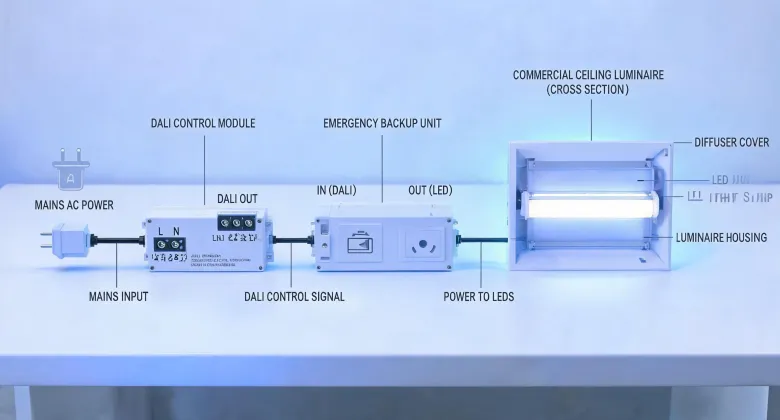
For a standard constant-voltage LED driver: input side is typically line, neutral, ground, and output side is V+ and V−. Observe polarity when connecting the strip. Some drivers have dimming inputs (0-10V or DALI) — those run separate low-voltage control wiring and shouldn't share conduit with line voltage. Actual wiring must follow the product instruction sheet and local electrical code — I'm not an electrician, I just get asked the basics often enough to know where the confusion starts.
One more thing: if you're pairing a DTL photocontrol with an LED driver, the control logic is that the photocontrol switches the AC feed, and then the driver outputs to the strip. Wire the sequence wrong and you can cook the driver on first power-up, or leave the photocontrol feeding the load during daylight.
Huge Chandeliers and Spotlight Streaming: When the Order Isn't Standard
Then there's the other category — the non-standard ask. An event production vendor suddenly needs a huge chandelier for a set piece, or a stage lighting crew needs continuous spotlight streaming coverage across a runway.
These orders run on different logic than standard commercial fixtures. Standard fixtures are 'match specs, locate stock, ship express.' Non-standard fixtures are 'find a manufacturer who can do it, confirm the tooling and sample timeline, see if expedited production is even possible.' Last year we handled a hotel atrium chandelier replacement — 1.8 meters in diameter, 11-tier crystal structure. The original vendor was discontinued. Normal production cycle 6–8 weeks. The customer gave us 10 days. We split the job across two manufacturers — one structural, one crystal — and handled consolidation and on-site technical briefing ourselves to make it.
My advice for non-standard orders: ask 'can you expedite' before you ask 'how much.' A vendor who can expedite typically quotes 30–60% higher — but you're buying a committed date. A vendor who can't expedite is worth nothing at any price.
When This Doesn't Apply
All of the above is based on our reality — a few thousand orders a year, a stable domestic supplier network, predominantly commercial and institutional clients. If you're doing small-batch retail restocking, or export projects with complex certification requirements, the failure points look completely different.
And I'll own this: I know DTL photocontrols and LED strip light well. On stage lighting and oversized chandeliers, my experience is thinner — I can tell you how to resource it fast, but the technical judgment should come from the manufacturer's engineering team.
Finally, on transparent pricing: list the driver, the mounting accessories, and any expedite fee up front. We'd rather quote a higher total than make the pre-shipment call that says 'there's an additional charge for the accessory.' Make that call once and the client doesn't reorder.