Three years ago, when I took over facilities and vendor ordering for our office, I assumed LED was LED. We needed a chandelier over a soaking tub in the executive suite, we needed a couple of closet chandeliers for the residential-style suites upstairs, and I figured I could buy them the same way I buy paper towels—skim the specs, pick a middle price, done. Turns out that logic cost me a lot more than the difference between one lighting brand and another.
Here's the thing. The question "which LED should I buy" doesn't have a single answer, because I've now bought LED products three genuinely different ways: fixed decorative fixtures, handheld task lights, and one time I got pulled into a specialized lighting project the facilities team was spec'ing. Each one has a completely different set of things worth checking before you place the order.
So here's what I've actually learned, sorted by which kind of buyer you are.
Scenario 1: You're buying decorative fixtures (bathtub chandeliers, closet chandeliers)
This was my first rodeo. In 2022 I ordered four chandeliers for the executive wing—one over a freestanding soaker tub and three in walk-in closets. I chose them based on how they looked in the vendor's catalog and whether the price fit the furniture budget. The one above the tub lasted eleven months before it started flickering so badly that the VP asked me if it was "supposed to do that."
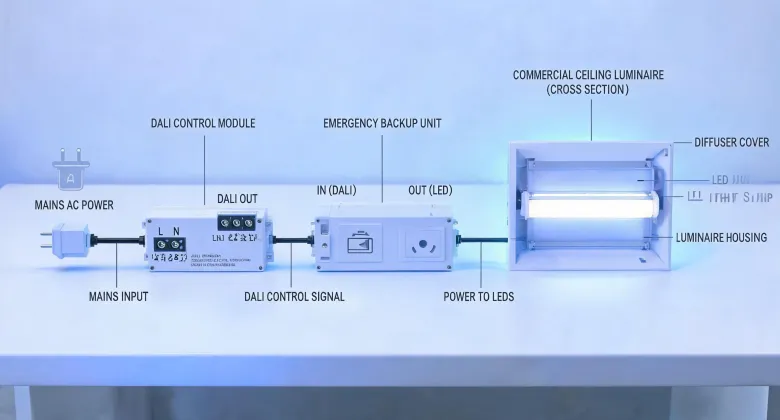
Here's what nobody told me the first time: for a fixture in a wet, steamy environment like a bathroom, what matters isn't the LED chip. It's the LED driver—the small component that converts your building's AC power into the regulated current the LED needs. If that driver isn't rated for damp locations, or if it's sealed permanently into the fixture, you are buying a disposable piece of decor. I had to replace the whole thing.
If you've ever wondered what an LED driver is actually used for—it's the tiny box most people never see, and it's usually the first thing to fail. Ask one question before buying any fixed fixture: is the driver integrated, or replaceable? If the answer is "integrated and sealed," and the fixture lives in a bathroom or a humid climate, walk away unless you're comfortable throwing the whole thing out when it dies.
For closet chandeliers, the priority flips. Now, CRI (color rendering index) matters more than anything. Clothes look one color under a dim, low-CRI fixture and something else entirely in daylight—which is how you end up with a client who ordered a navy suit and received what looks like charcoal. A CRI of 90+ is what I'd call the baseline for any closet or dressing area. Below that, the return requests start piling up.
The counterintuitive part: the most expensive fixture in the catalog is not automatically the safest choice. In my experience, a mid-priced fixture with a replaceable driver and a documented 90+ CRI beats a luxury-brand fixture with a sealed driver every time—because the failure mode is different. One is a $40 driver swap. The other is a $600 hole in your furniture budget.
Scenario 2: You're buying a high-CRI task light (like the Nitecore MT06MD-PG with a Nichia 219B)
Our facilities team needed inspection lights for the maintenance crew—small penlights they could clip and carry. I got pulled into this because procurement has to approve anything with a spec sheet, apparently.
If you're shopping in this category, the LED designation is the whole ballgame. The Nitecore MT06MD-PG uses a Nichia 219B LED—that's a specific emitter, not a marketing name, and it's beloved in the flashlight community for color accuracy rather than raw output. The 219B is a high-CRI emitter, which means when your tech is trying to match paint colors or inspect carpet damage under ambient lighting, the colors look like the colors. Bottom line: with a 219B in the light, what you see is closer to what you'd see in daylight.
Here's where I made a rookie mistake, actually—I initially compared these penlights on lumens alone. Our maintenance lead had to explain to me, patiently, that a 1,000-lumen light with a low-CRI emitter is worse for color inspection than a lower-output light with a proper high-CRI LED. If the whole point is seeing colors correctly, output matters less than emitter quality. The Nichia 219B in that Nitecore is the reason the spec sheet reads the way it does.
What I'd check before ordering this type of light for a team:
- Emitter designation — is it a named LED (Nichia 219B, for example) or just "high-quality LED"? The named one is verifiable. The other one you're taking on faith.
- CRI rating — for inspection work, you want a documented number, not a vibe.
- Battery compatibility — a penlight that uses a proprietary cell your team can't recharge on-site is a paperweight with a clip.
One more thing: buy one and test it before you buy twelve for the crew. I've been burned by bulk orders that looked right on paper. Facilities staff will tell you within five minutes whether a light works for their actual job.
Scenario 3: You're involved in a professional or automotive lighting project
Last year I got pulled into a specialty project where a partner organization was upgrading a fleet vehicle's lighting, and our procurement team was asked to help vet the components. That's where I first encountered the phrase "Nichia laser headlight" and realized there's an entirely separate world of LED procurement that runs on datasheets rather than catalogs.
In this tier, you're not buying a finished fixture—you're buying or specifying a component or a system with regulatory and safety implications. Nichia is one of the named suppliers in this space because of their laser and UV LED work, and the spec language changes accordingly. The questions are different. Instead of "does it look nice," you're asking about thermal management, documented lifetime curves, and safety certification.
My advice if you're dragged into one of these projects: do not sign off on anything without the datasheet. I don't mean the marketing page. I mean the actual document with the lifetime derating curves and safety classification. If a vendor can't provide it—or gets cagey when you ask—that is a red flag. Full stop.
And I'll say this, because it surprised me: the pace of change in this category is genuinely fast. What was best practice in 2021 for specifying certain automotive LED systems may not apply in 2025. If you're working off five-year-old assumptions, verify them with someone current before the purchase order goes out.
So which buyer are you?
Three quick questions, and you'll know which checklist to use:
- Is the light fixed to a wall or carried in a pocket? Fixed → Scenario 1. Carried → Scenario 2.
- Are you buying a finished product or specifying a component? Finished → Scenarios 1 or 2. Component → Scenario 3.
- Is the lighting serving decoration, inspection, or a regulated system? Decoration → verify the driver. Inspection → verify the emitter and CRI. Regulated → verify the datasheet and safety certification.
I have mixed feelings about how much time this all takes. On one hand, I miss the days when I could just pick the prettiest thing in the catalog and move on. On the other, I've now seen how a $40 LED driver or a vaguely-specified emitter can wipe out months of budget goodwill. The fundamentals of procurement haven't changed—you still want the right product at a fair price. What's changed is how much specific knowledge "the right product" now requires.
Take it from someone who's now replaced a bathroom chandelier and explained the word "CRI" to a VP: verify before you buy. Every scenario, every time.