-
There is no universal lighting spec—only the right spec for the scenario
-
Scenario A: Decorative statement fixtures—Flos String Light Cone and Flos Chiara Floor Lamp
-
Scenario B: Accent and display lighting—spotlight banner and yellow spotlight
-
Scenario C: Retrofit and driver-led upgrades—what does a driver do for LED lights?
-
How to tell which scenario you’re in
There is no universal lighting spec—only the right spec for the scenario
I’m a quality and brand compliance manager for a lighting company. I review every fixture specification and first-article sample before it reaches customers—roughly 200+ SKUs and custom configurations annually. In Q1 2024, I reviewed 238 unique submittals and rejected about 18% of first deliveries, mostly for driver compatibility, finish inconsistency, or dimming behavior. I say that not to sound impressive, but because lighting decisions fail when people treat decorative, accent, and retrofit work as one category.
If you are specifying Flos, a spotlight banner, a yellow spotlight, or an LED retrofit, start by naming the job the light has to do. That is the branch point. The spec sheet follows the scenario, not the other way around.
I’d rather spend 10 minutes explaining options than deal with mismatched expectations later. An informed customer asks better questions and makes faster decisions.
Scenario A: Decorative statement fixtures—Flos String Light Cone and Flos Chiara Floor Lamp
This is the scenario where the fixture is part of the architecture or the interior composition. The Flos String Light Cone and Flos Chiara Floor Lamp are good examples: the visual line, cable drop, shade finish, and dimming feel matter as much as lumen output. A client may ask for “the Flos look” without realizing that the look is partly a quality-control issue—cable jacket diameter, paint consistency, diffuser alignment, and driver location all affect what the eye sees.
In this scenario, I check three things first: suspension or cable length against the ceiling detail, driver accessibility after installation, and dimming compatibility with the specified control system. The driver is often hidden in a canopy, base, or remote enclosure. If it is not accessible, a future service call becomes a ceiling or floor intervention. That is not a decorative problem. It is a cost problem.
To be fair, decorative fixtures often hide the driver so well that it is easy to forget. That is exactly why it belongs in the submittal. For Flos String Light Cone installations, confirm the exact drop and the ceiling anchor method before release. For Flos Chiara Floor Lamp, confirm the dimming protocol and the floor sample finish under the project’s actual color temperature. A finish that reads warm under 2700K can look muddy under 3500K.
In our Q1 2024 audit, a batch of 120 pendant cones showed a 6% variance in cable jacket diameter against our visual standard. The vendor called it normal production tolerance. We rejected the batch and added a measured cable spec to every contract. The redo cost the vendor, but it protected the brand.
Scenario B: Accent and display lighting—spotlight banner and yellow spotlight
This scenario is about controlled attention. A spotlight banner—usually a promotional banner lit by a dedicated spotlight—needs a narrow beam, clean cut-off, and enough color rendering to keep brand colors from going flat. A yellow spotlight can be a deliberate warm accent, but it can also be a symptom: wrong color temperature, a filter that shifts over time, or a driver that is not delivering stable current.
For a spotlight banner, I specify beam angle before wattage. A 15-degree beam on a 3-meter throw can create a hot spot and leave the banner edges dark. A 24- to 36-degree beam often gives more even coverage, depending on the throw distance. I also check glare control and spill. In retail, spill light on the ceiling or adjacent wall can read as sloppy even when the banner itself is well lit.
For a yellow spotlight, define the target color in numbers—CCT, CRI, and if needed, a color target or gel reference. “Warm yellow” is not a specification. In one project, we saved $60 by using a non-dimmable driver on a display sample. Actually, it was closer to $80 with the discount. We ended up spending $780 on a reshoot and replacement because the yellow shifted when the store dimmed the circuit. That is the classic penny-wise, pound-foolish move.
I’m not 100% sure why yellow spotlight requests so often skip color targets. My best guess is that the effect feels intuitive—people point at a warm scene and say “like that.” But LED color is not a mood board. It is a measurable output.
Scenario C: Retrofit and driver-led upgrades—what does a driver do for LED lights?
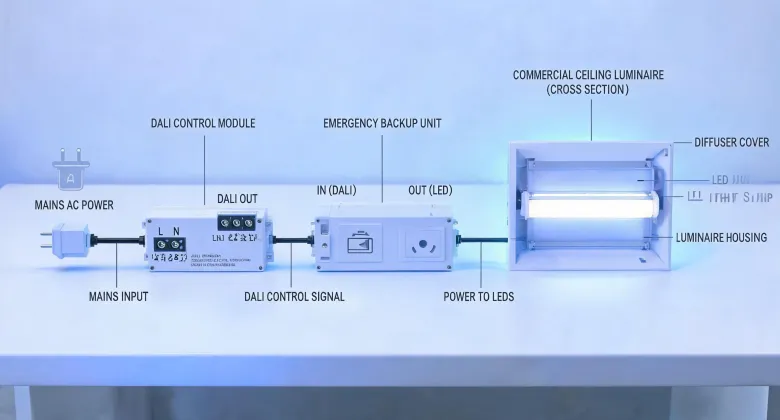
This is the scenario where the fixture is fixed but the light engine or control is changing. The question “what does a driver do for LED lights?” is the right question. An LED driver converts incoming AC power to the DC power the LED module needs, and it regulates current so the LEDs do not overdrive or flicker. It also affects dimming, inrush current, thermal behavior, and service life. A driver is not just a power supply. It is the control and protection layer.
For retrofit work, I separate constant-current from constant-voltage drivers, then match the dimming protocol: TRIAC, 0-10V, DALI, or another control system. I check the driver’s minimum load, maximum ambient temperature, and whether it is rated for the enclosure. A driver tucked into an insulated ceiling or a closed base can fail early even if its datasheet looks fine on a bench.
This was true 10 years ago when halogen transformers were simple and interchangeable. Today, the driver is a specified component with its own standards and limits. According to UL Solutions, LED equipment for lighting products falls under UL 8750; IEC 61347-2-13 covers DC or AC supplied electronic controlgear for LED modules. Those references are not a substitute for local electrical code, but they are a useful check on whether the driver is being treated as a real component rather than an afterthought.
In my first year, I made the classic specification error: assumed “standard dimming” meant the same thing to every vendor. Cost us a $2,400 rework on a small hospitality job. Now every submittal includes the exact dimming protocol, driver model, and a mock-up test.
How to tell which scenario you’re in
Use these questions as a decision tree. If the fixture is the visual statement—Flos String Light Cone, Flos Chiara Floor Lamp, or a similar decorative piece—you are in Scenario A. Prioritize finish, cable or suspension detail, driver access, and dimming feel.
If the job is to direct attention to a surface or object—spotlight banner, yellow spotlight, retail display, or gallery wall—you are in Scenario B. Prioritize beam angle, color target, glare control, and spill.
If you are keeping the fixture but changing the light source or controls—especially any LED retrofit—you are in Scenario C. Prioritize driver type, current, dimming protocol, thermal rating, and service access. If you cannot answer what driver is inside, you are not ready to release the spec.
One last quality check: ask for a sample under the project’s real control system. Not a bench demo. Not a catalog photo. The real dimmer, the real ceiling height, the real ambient light. That is where mismatched expectations show up. And that is where a quality inspector earns their keep.
Disclaimer: Standards and code requirements change. Verify current UL, IEC, and local electrical requirements with official sources before specification.