-
The $47,000 Mistake That Had Nothing to Do with Lamp Prices
-
Mistake #1: The "Cheaper" Bega Lighting Distributor That Cost Us $8,400
-
Mistake #2: Mixing Exterior Spotlight and Downlight LEDs on the Wrong Driver
-
Mistake #3: We Tried to "Hide" LED Strip Lights and Buried a Maintenance Nightmare
-
"But Doesn't All This Verification Cost More Up Front?"
-
The Pre-Check List I Wish I'd Had in Year One
The $47,000 Mistake That Had Nothing to Do with Lamp Prices
I've been a senior spec sourcing specialist handling commercial outdoor lighting orders for nine years. I've personally made — and documented — 23 significant mistakes, totaling roughly $47,000 in wasted budget and rework. Some of those were my errors. Some were ones our clients made that we had to clean up. Now I maintain our team's pre-check list to keep others from repeating them.
Here's what I've learned the hard way: in commercial outdoor lighting projects, your biggest cost driver isn't the price per fixture. It's spec errors, driver incompatibilities, and mid-project change orders.
I've argued this internally for years now, and I still get pushback from procurement teams who want to negotiate the unit cost down. But the math doesn't lie. If you save 5% on a $200,000 area lighting package by chasing the cheapest quote, and then you eat $8,000–$12,000 in emergency re-specs because a distributor can't stock what they quoted, or because you mixed driver ecosystems, you've returned that savings — with interest.
What actually matters is a streamlined spec-sourcing process: verified distributor stock, pre-validated circuit compatibility, and maintenance access planned from day one. That's where cost and time advantages live.
Let me prove it with three stories. These aren't hypotheticals — they're logged on my error sheet.
Mistake #1: The "Cheaper" Bega Lighting Distributor That Cost Us $8,400
In September 2022, I was comparing quotes for a commercial landscape package built around bega wall lights. One distributor quoted 12% below our regular supplier — same spec, same fixtures.
I placed the order.
"Lead time is six weeks," they said.
The project was three weeks from completion. And the client — a general contractor with penalty clauses — had specified bega wall lights explicitly for their architectural finish. They weren't going to accept a "close enough" substitute.
I called the distributor back. Did they have the material in stock? No. They ordered from the factory, the factory shipped to them, and they forwarded to us. Six weeks was their normal turnaround, not an exception.
We ended up buying from another bega lighting distributor that happened to have limited stock — at 18% above the original quote. Different production batch, slightly different finish. The GC noticed. I had to explain that to the client and the lighting designer in the same call.
Direct loss: $8,400 (rush fees, higher unit cost, and a contractor penalty we couldn't contest because the delay was on our side).
The lesson I wrote on our pre-check list: "Bega lighting distributors" is a label, not a guarantee. Ask for written stock confirmation — not "estimated lead time." A distributor that doesn't carry inventory is a broker with a markup, and the markup always shows up when you're under pressure.
Mistake #2: Mixing Exterior Spotlight and Downlight LEDs on the Wrong Driver
Early 2023, we specced a commercial patio project. We used bega exterior spotlights for the perimeter wash — standard practice. To trim the budget, we substituted a lower-cost brand for the downlight LEDs that handled the ambient layer.
Everything looked fine on paper. The footprints matched. The lumen output was close enough.
Then we powered up the circuit during commissioning, and half the downlight LEDs started flickering.
Our senior electrician put it bluntly: "You've got incompatible drivers." The bega exterior spotlights had integrated wide-voltage drivers. The cheaper downlight LEDs required specific input frequencies to avoid flicker. They were sharing a circuit.
We replaced all 24 downlight LEDs with models that matched the existing driver ecosystem. Cost: $6,200 in new fixtures and labor. Plus three days of commissioning delay that pushed the whole handover schedule.
What I should have done — and now insist on — was bench-test a single fixture from each brand on the same driver before placing the full order. It takes an hour in the workshop. It would've saved us $6,200 and a very awkward phone call.
The broader lesson: spec consistency isn't about brand loyalty. It's about verified circuit compatibility. You can mix brands on separate circuits. You cannot mix driver ecosystems on the same circuit and assume it'll work because the voltage numbers look close.
Mistake #3: We Tried to "Hide" LED Strip Lights and Buried a Maintenance Nightmare
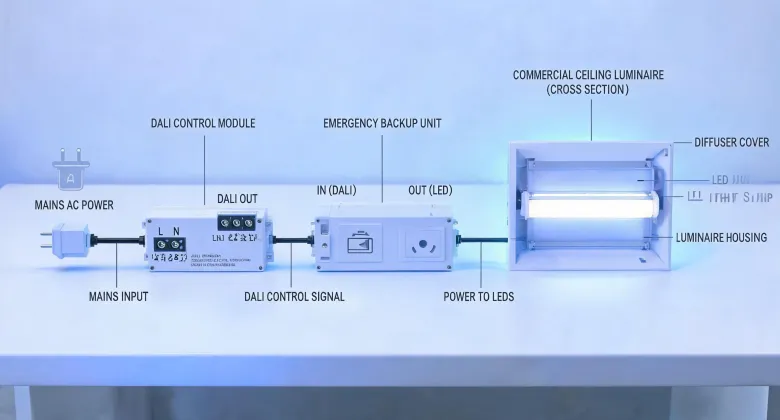
This one still stings. In 2021, on a high-end commercial landscape project, the client's landscape architect wanted ultra-clean lines — no visible fixtures anywhere. We used bega LED strip lights and concealed them in a deep concrete channel, flush with the paving.
Aesthetically, it was beautiful. Functionally, it was a trap.
The channel had a flat slope. Water pooled around the strip after every rain. The IP rating was adequate for direct exposure, but continuous immersion degraded the silicone seals over about 18 months. Then the driver failed.
To replace it, we had to cut into the cured concrete. The repair cost $9,100 in labor and materials. The client didn't blame the fixture — they blamed us for designing something they couldn't maintain.
So when people search "how to hide LED strip lights," I tell them what I wish someone had told me: in outdoor environments, concealment is the last thing you plan, not the first. Here's what actually works:
- Use an aluminum extrusion with built-in drainage channels, not a sealed concrete slot
- Mount the strip in an accessible reveal — a removable cap or panel — rather than pouring concrete around it
- Apply a secondary waterproof sealant along the strip edges before final install
- Confirm the IP rating against the actual installation environment, not the product datasheet
You can still achieve the clean look. But plan the maintenance access before the pour. Every time.
"But Doesn't All This Verification Cost More Up Front?"
I hear this pushback from procurement teams every quarter. And honestly, yes — sometimes the upfront number is higher. A 10% premium on fixtures that come with verified stock and compatible drivers is still a premium.
But here's the ratio I've tracked across 23 logged errors: the cost of a mid-project correction is roughly 3–4× the original line item. That's not an industry statistic — that's my internal error log. Rush shipping, expedited labor, penalty clauses, and the soft cost of a client who now questions every spec you submit.
I'm not a structural engineer, so I can't speak to concrete load calculations or channel depth requirements. What I can tell you from a spec sourcing perspective is this: the efficiency gain isn't in the unit price. It's in the reliability of the process.
And to be fair, I can only speak to our context — mid-size commercial projects in the $150K–$400K range with eight-week delivery windows. If you're dealing with large-scale infrastructure or multi-phase developments with longer lead times, the calculus might be different. But the core principle holds: verifiable specs beat cheap quotes.
If you ask me, the industry as a whole is moving toward process efficiency — and that's good for everyone. But it starts with admitting where the real costs sit.
The Pre-Check List I Wish I'd Had in Year One
These are the five items on my current checklist. None of them are complicated. All of them would have saved me at least one of those $47,000 mistakes.
- Request written stock confirmation from every distributor before placing a bega lighting package order. "Estimated lead time" is not stock confirmation.
- Bench-test driver compatibility whenever you mix fixture brands on the same circuit — even if the voltage specs match.
- Plan maintenance access before finalizing any concealed LED installation. If you can't reach it without demolition, redesign it.
- Treat "cheapest quote" as a warning sign, not a win. Ask what's missing: stock? compatibility verification? post-sale support?
- Validate IP ratings against the actual environment — pooled water, chemical exposure, temperature cycling — not just the product label.
The $47,000 taught me something I couldn't learn from a catalog: efficiency isn't about cutting corners on price. It's about making sure the corners don't get cut on you.