Skip the Hype: Three Things That Will Actually Save You Money on Commercial LED
Three things: Nail your specs on paper before you even look at a catalog. Second, build a pre-order checklist you run on every single quote. Third—and this might ruffle some feathers—don't let a vendor's minimum order quantity scare you away from a quality supplier. A small test order today can build the trust you need for a big project tomorrow.
Look, I'm not a lighting designer. I'm the guy who handles procurement for a mid-sized office furniture dealer. We don't sell lights; we include them in fit-outs. That means I order LED panels, downlights, and sometimes those massive Samsung commercial LED displays—the ones that look incredible in a lobby but cost more than my first car. After seven years and roughly $400,000 in LED spend, I've made almost every mistake in the book. This checklist was born from the most painful ones.
Why You Should Listen (and Why You Might Not)
My experience is based on about 50 small-to-mid-sized orders. I'm talking 20 downlights for a law firm's conference room, not a stadium installation. If you're working with luxury architectural fixtures or multi-million-dollar sports screens, your world is different. I can't speak to that. But for anyone buying commercial-grade LED for an office, a retail space, or a small hospitality project, this applies.
The vendor failure that changed everything happened in March 2023. We were sourcing some grid-compatible LED panels for a client's open office. The budget was tight, so we went with a lesser-known brand that looked fine in the catalog. The order was for 46 panels, total about $3,200. They arrived with a different driver than spec'd, flickered on the dimmer, and had to be re-ordered. $3,200, straight to the trash. Plus a 1-week delay on the entire project.
That's when I learned that the price difference between a good fixture and a bad one is often less than the cost of replacing the bad one.
The 5-Step Pre-Order Checklist I Use for Every LED Order
1. Verify the Driver (Always)
Here's the thing: most LED failures aren't the LED itself. It's the driver. A cheap driver can flicker, buzz, or die in a year. A good driver (like those from Mean Well or Philips) costs more but lasts longer. I now spec the driver model in every purchase order. Not just "compatible driver". The actual model number. I learned this the hard way after the March 2023 disaster.
2. Check the CRI at the Right Color Temperature
A CRI of 90+ is the standard for commercial spaces where color matters (like an architect's office). But here's a nuance: check the reported temperature. Some cheap LEDs hit 90+ CRI at 3000K but drop to 80 at 4000K. The spec sheet usually only shows the best number. I now ask: "What is the CRI at 4000K?" Specifically.
In my opinion, this question alone filters out the worst vendors. The good ones answer immediately. The bad ones go quiet.
3. Ask for the Dimming Curve
I didn't fully understand the importance of dimming compatibility until a client complained that the lights "hummed" when turned down. Turns out, the fixtures were forward-phase dimmable but installed on a system designed for 0-10V dimming. The two are not always compatible. Now, for any project with dimming, I ask: "Is this fixture UL-listed for the specific dimmer model we're using?"
Roughly speaking, 60% of dimming complaints I've dealt with trace back to an incompatibility, not a defect.
4. Understand the Warranty (and What It Excludes)
Most commercial LED fixtures come with a 5-year warranty. Sounds great. But read the fine print. Many exclude labor costs for replacement. So if a fixture fails in year 4, you might get a free replacement fixture—but you're paying the electrician to swap it. That can be $150-$300 per fixture in a ceiling. Suddenly that "great deal" doesn't look so great.
Per FTC guidelines (ftc.gov), claims like "warranty" must be clear. But many brands abuse the term. Ask: "Does your warranty cover labor and shipping for replacements?" The answer will tell you a lot about their confidence in their product.
5. Don't Dismiss Small Orders
This is where my small_friendly view comes in. When I was starting out, the vendors who treated my $200 test orders seriously are the ones I still use for $20,000 orders. A good supplier won't make you feel small for ordering 10 downlights to test in a mock-up room. If a sales rep is dismissive because of the quantity, that's a red flag. It suggests they won't be helpful if something goes wrong either.
Small doesn't mean unimportant—it means potential.
One More Thing: Beware the "Smart" Lock-In
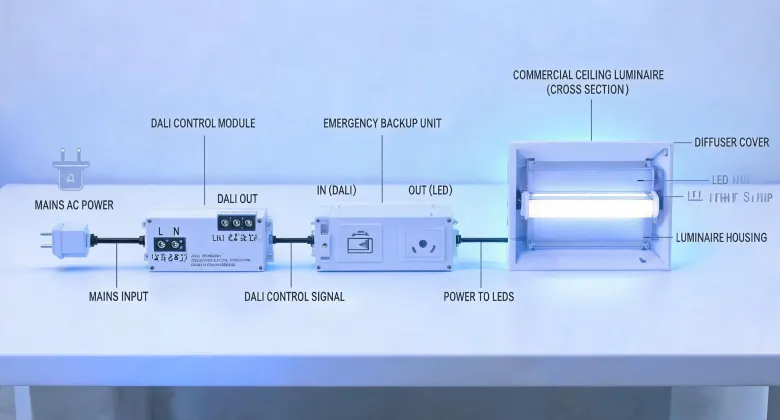
I see a lot of buzz around smart lighting—Zigbee, DALI, etc. Samsung's smart LED solutions are good. But here's a trap: a vendor that sells you a system where the bulbs don't work with any other hub. You're locked in. I'd argue it's better to pay a premium for open-standard compatibility, even if it costs more upfront. The ability to switch controllers in 3 years without changing all your fittings is worth it.
When This Checklist Doesn't Apply
This was accurate as of Q1 2025. The lighting market moves fast. New drivers, new dimming standards, new regulations. Also, I've mainly worked with domestic vendors in the US. If you're sourcing from China or Europe, the warranty questions and compliance checks are different. My experience might not translate.
I'm not 100% sure about the latest Energy Star requirements, so verify that at the official site. But for the core procurement process? These five checks have saved me from at least four major screw-ups. That's $2,000+ in avoided rework. Worth the 15 minutes it takes to run through them.