-
This Checklist Is for When You Can't Afford Downtime
-
Step 1: Shut Off the Power at the Breaker, Not Just the Switch
-
Step 2: Identify the Track Head and Base Type Before You Touch Anything
-
Step 3: Wait for the Bulb to Cool—or Use a Cloth
-
Step 4: Remove the Bulb or the Entire Track Head—Know the Difference
-
Step 5: Check the Downlight Driver—Don't Skip This
-
Step 6: Match the Replacement—Wattage, Color Temp, and Beam Angle
-
Step 7: Secure Everything and Test
- Notes from the Field: Four Things That Burn People
-
One More Thing: Check the Rest of the Space
This Checklist Is for When You Can't Afford Downtime
If you're reading this because a track light just went dead before a client walkthrough or a store opening, let's skip the theory and get to what works. I've coordinated emergency lighting fixes for over six years—at this point, I've lost count of how many same-day track light repairs I've managed. It's usually restaurants, retail shops, or small hotels calling, and their common thread is this: they don't have three to five days to wait for an electrician.
Replacing track lighting bulbs sounds dead simple until you're staring at a ceiling with four different track head types. So here's the checklist we use when the clock is running—7 steps, no fluff.
Step 1: Shut Off the Power at the Breaker, Not Just the Switch
I know it feels like overkill. The switch is right there, so why walk to the breaker panel? Because the wall switch doesn't always cut power to the entire track—and some systems are wired so the socket can still be live even with the switch off. If you're reaching up to remove a bulb, you don't want to learn that the hard way.
At minimum, flip the wall switch off and the breaker. If you have a voltage tester, use it—it's a $15 tool that's saved me from getting zapped more times than I can count. And if you're on a ladder in a hurry, that's exactly when accidents happen.
Step 2: Identify the Track Head and Base Type Before You Touch Anything
This is the step everyone skips, and it's why so many emergency replacements turn into two trips to the hardware store. Track lighting isn't one standard system. You've got:
- GU10 bulbs (twist-and-lock base)
- MR16 bulbs (two pins, usually with a separate driver)
- PAR30 / PAR38 bulbs (bigger, screw-in or pin base)
- Integrated LED track heads (the whole head is the light—no replaceable bulb)
Take a photo of the bulb before you remove it. Most bulbs have the model printed on the base. Trust me, matching a GU10 to a GU10 is a two-minute fix. Trying to force an MR16 into a GU10 socket is how you create a $200 repair out of a $5 problem.
Step 3: Wait for the Bulb to Cool—or Use a Cloth
Track lighting, especially halogens, runs hot. If the light was on, give it a few minutes to cool down. If you're in a rush (and I know you are, since you're doing this as an emergency), use a dry cloth or gloves. Just don't do what I did early in my career and grab a still-warm halogen with bare fingers—not only did I drop the bulb, the oil from my skin made the replacement bulb fail faster. Halogens and bare-hand contact don't mix.
Step 4: Remove the Bulb or the Entire Track Head—Know the Difference
Here's where it gets practical. Some track heads have a clip or twist-lock mechanism that lets you pull the whole head off the track. Others mount directly and only the bulb comes out. If the head itself is damaged (cracked socket, melted plastic), replace the whole head. If only the bulb is dead, just swap the bulb.
One thing I've learned the hard way: when removing a track head, hold onto the base, not the bulb. The base has the prongs that lock into the track, and twisting the bulb instead of the base can snap the connector pins. That's a "now you have a bigger problem" moment if I've ever seen one.
Step 5: Check the Downlight Driver—Don't Skip This
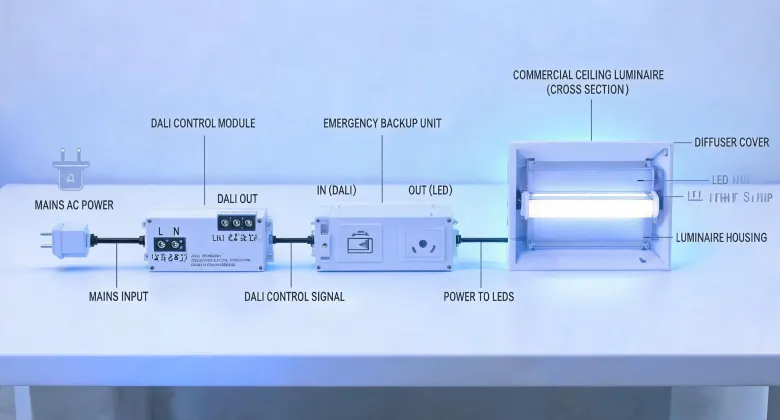
This is the step most people overlook, and it's the one that separates a 10-minute fix from a two-hour ordeal. If you're replacing a downlight (the recessed-style track heads that look like miniature can lights) and the bulb is MR16-style, there's a driver involved. The driver is the little transformer that steps down the mains voltage to 12V or 24V.
Here's the thing: when a downlight stops working, it's often the downlight driver that has failed, not the bulb. I can't tell you how many times I've seen someone swap three bulbs, only to realize the driver was dead the whole time.
Quick way to test: take the bulb out and check if the driver is feeding voltage to the socket. No multimeter? Try swapping in a known-good bulb from a working fixture. If it doesn't light, it's the driver, not the bulb. Replacement downlight drivers usually run $10–30 depending on wattage (based on supplier quotes we got in Q4 2024; verify current pricing).
Step 6: Match the Replacement—Wattage, Color Temp, and Beam Angle
This is where I'll get a bit picky, because it matters more than people think. In a retail space, color temperature changes how products look. A 3000K warm light makes a clothing store feel inviting; a 5000K cool light is better for workshops. Replacing a 3000K bulb with a 4000K one might not seem like a big deal, but in a restaurant, your guests will notice the difference in ambiance.
Check the label on your old bulb or track head for the lumen rating and color temperature (measured in Kelvin). Putting in a dimmer replacement will just feel like another failure—and it's not the fixture's fault.
In the last couple of years, we've standardized on Samsung LED technology for a lot of our projects. The color consistency between fixtures is noticeably better, and the LEDs hold up longer than the cheap alternatives. If your budget allows, I'd recommend going with a reputable LED brand over generics—not because generics don't work, but because color fade is real. I've seen "matching" bulbs from two brands look completely different after six months.
Step 7: Secure Everything and Test
Push the new bulb in until it clicks (GU10) or aligns correctly (MR16). Then reattach the track head to the rail. Restore power at the breaker, flip the switch, and verify it works—before you get off the ladder. If it doesn't light, kill the power again and double-check the base type, because a loose connection is the usual culprit.
If you're replacing multiple bulbs on the same track, do the dead ones first, test, then assess the rest. No point replacing every bulb if only two of eight are out—unless you're seeing color inconsistency, which I'd address by swapping them all to the same model.
Notes from the Field: Four Things That Burn People
1. The Cheapest Bulb Online Is Often the Most Expensive Choice
I have mixed feelings about how we think about bulb cost. On one hand, a $4 no-name LED looks like a bargain next to a $9 Samsung LED. On the other, after the third time a cheap bulb flickers out at 8 PM on a Friday before a weekend event, you start doing the math differently. The total cost of lighting maintenance includes your time, the rush delivery fee, the ladder setup, and doing the job twice. The cheap bulb isn't cheap if it fails at the worst moment.
2. Don't Mix Wattages on the Same Track
If a track was designed for 35W halogens and you put in a 10W LED, it'll work fine. But if you replace some bulbs with 10W LEDs and leave others as 35W halogens, you'll get uneven light that looks broken even when it isn't. It's not usually a safety issue—it's a consistency problem.
3. Integrated LED Track Heads Can't Be Rebulbed
Some modern track heads have the LED chips built in—no replaceable bulb. When those fail, you replace the whole head. Check warranty status before buying new ones. I once watched a client almost order 12 new heads when two were still covered under warranty.
4. Know When to Call an Electrician
I'm not an electrician, so I can't speak to rewiring, line-voltage issues, or anything beyond swapping bulbs and drivers. What I can tell you from a coordination perspective is this: if a new bulb still doesn't work after you've confirmed it's a good bulb, the problem isn't the light. Call a licensed electrician. The $150 service call is cheaper than the liability of messing with wiring you don't understand.
One More Thing: Check the Rest of the Space
Since you've already got the ladder out and you're in emergency mode, take two minutes to audit the other lights in the room. In my experience, these situations never happen alone—the track light goes, and then you notice the exit sign is flickering or the LED panel in the back office is out. One memorable project was a hotel lobby where we fixed the track lighting, only to realize the wall-mounted display had been "dead" for a week. It turned out the Samsung Ultra HD 4K LED Smart Tizen TV was fine—someone had changed the power settings. Sometimes the dead fixture is just a settings issue.
And if you're outfitting a space from scratch, the Samsung 114" class Micro LED Smart TV (2024) is worth a look for commercial lobbies. It's bright, it's massive, and it sits naturally alongside Samsung's broader LED ecosystem. But that's a planning conversation, not an emergency one.
This checklist reflects what I've learned coordinating 200+ rush lighting jobs since 2019. Product availability and pricing were accurate as of January 2025—the market changes fast, so verify current specs before ordering. If you're ever in a true pinch, your best insurance is keeping a few spare bulbs and a working downlight driver on hand before the emergency. But since you're here now, start with Step 1.