-
Who this checklist is for (and what it covers)
-
Step 1: Inventory everything before you open a supplier tab
-
Step 2: Match the luminaire to the space, not to the catalog
-
Step 3: Verify control compatibility before committing (my rookie mistake)
-
Step 4: Order one sample and test it in the actual room
-
Step 5: Size the display to the room, not the showroom
-
Step 6: Ask about the replacement-parts path, not just the product
-
Step 7: Confirm the paperwork before the invoice lands
-
Step 8: Plan the installation like a project, not an errand
-
Common mistakes I still see (and one search that keeps landing here)
If you're the one who gets stuck ordering lighting and displays for your office, read this before your next purchase. I'm an office administrator for a 200-person company, managing roughly $180,000 in annual purchasing across 9 vendors—including every Samsung-LED fixture, crystal chandelier, and conference-room TV we own. When I took over purchasing in 2020, I had no idea how many ways a lighting order could go sideways. Five years later, I've made most of them.
This is the 8-step checklist I run before every lighting or display order. It has saved us—conservatively—$12,000 in rework, rush fees, and replaced fixtures. And it'll save you the awkward conversation I once had with our VP after the lobby lighting arrived in the wrong color temperature.
Who this checklist is for (and what it covers)
This is for B2B buyers, office administrators, and facility coordinators upgrading commercial spaces—office lobbies, conference rooms, hallways, and retail interiors. If your shopping list includes any of the following, you're in the right place:
- Commercial LED downlights and indoor spotlights
- A crystal chandelier for a lobby or entry area
- A Samsung LED TV or display for meeting rooms
- Replacement parts for legacy displays (like the Samsung 2013SVS55F we'll talk about below)
Step 1: Inventory everything before you open a supplier tab
Every order starts with a physical walkthrough. Not a spreadsheet from last year—an actual walk with a notebook. We've processed maybe 200 lighting orders in five years. Maybe 180, I'd have to check the system. But every single mistake we've had traces back to skipping this step.
Write down per room:
- Fixture types: downlight, spotlight, chandelier, wall sconce
- Current control systems: dimmers, occupancy sensors, smart hubs
- Existing TV models, sizes, and mounting type
This is also when you catch the legacy items. We have a Samsung 2013SVS55F (55-inch, from 2013) still mounted in our secondary boardroom. Its LED backlight strip failed last year—and if you're searching for "strip led tv samsung 2013svs55f" replacement parts, you're not alone. Because we had the model number on our inventory sheet, we sourced the right parts in 48 hours instead of panic-buying a new TV.
Step 2: Match the luminaire to the space, not to the catalog
Different spaces need different lighting families. This sounds obvious, but it's the most common over-order I see. The 'spotlight indoor' product category—accent lighting for interior spaces—is where most of our conference-room orders come from. In our lobby, we specified a chandelier crystal fixture—not for looks (well, partly), but because it provides ambient light that reflects off the stone finishes. In the conference room, we paired indoor spotlights for accent lighting on the whiteboard wall with LED downlights for general brightness.
What worked for us:
- Lobby/reception: crystal chandelier or decorative pendant, with LED-compatible drivers
- Conference rooms: adjustable indoor spotlights + downlights on separate dimming circuits
- Hallways/open areas: high-efficiency LED downlights, occupancy-sensor ready
Step 3: Verify control compatibility before committing (my rookie mistake)
In my first year, I made the classic specification error: assumed "standard" meant the same thing to every vendor. We ordered 80 downlights that worked fine on a plain switch, but our building uses a Zigbee-based smart lighting system. Zigbee, in case you haven't had the pleasure, is a wireless standard used by many smart lighting and IoT devices. Our new fixtures weren't Zigbee-compatible. Cost me a $600 restocking fee and a week of schedule slip.
Before you order, confirm:
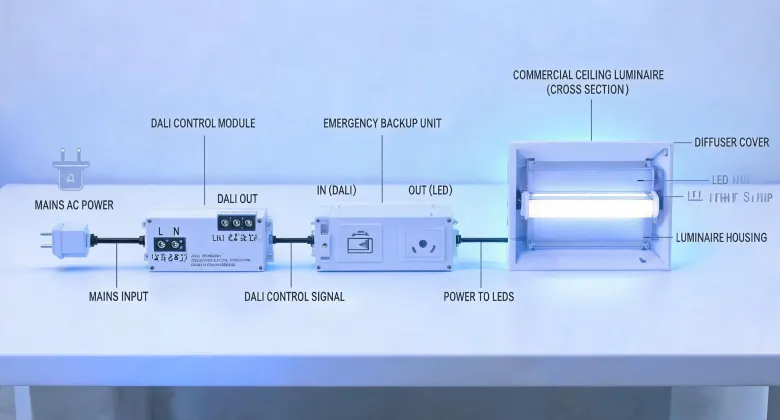
- Your current system: Zigbee, 0-10V dimming, DALI, or standalone
- The exact driver model and compatibility spec from the supplier—in writing
- The dimming range. For most offices, 10%–100% is fine. For an AV-rated boardroom, you'll want 1%–100% (well, only if you actually record meetings there—turns out we do, and I wish I'd known that earlier).
Step 4: Order one sample and test it in the actual room
You cannot evaluate color quality from a datasheet. In 2022, I approved a batch of 120 indoor spotlight fixtures based on the CRI number on the spec sheet. CRI—Color Rendering Index—measures how accurately a light reveals colors, and a high number on paper doesn't guarantee a pleasant beam in practice. The actual install made our branded fabric look washed out. 120 fixtures. Wrong look. Full redo.
The fix is embarrassingly simple: order a single unit, install it in the target space, and check:
- Put the sample next to the paints, fabrics, and flooring it will light
- Test it during the day and at night—natural light changes perception
- Check for flicker with your phone camera. If you see banding, reject it.
5 minutes of verification beats 5 days of correction. The 12-point checklist I built after my third mistake has saved us an estimated $8,000 in potential rework.
Step 5: Size the display to the room, not the showroom
Conference-room TV sizing is where I see the most over-engineering. For a small huddle room with a 6-foot viewing distance, a Samsung 40 inches LED TV is genuinely the right call—we have four of them on our standard spec. For a 12-seat boardroom, the same 40-inch model looks startlingly small (don't ask how I know).
A common rule: comfortable viewing distance for full-HD is about 1.5–2.5 times the screen diagonal. For a Samsung 40 inches LED TV, that puts viewers 5–8 feet from the screen. If your back row sits beyond that, size up or move to 4K (which allows larger screens at closer distances without visible pixelation).
When we consolidated vendors in 2024, we standardized on the Samsung 40 inches LED TV for huddle rooms and 65-inch units for the main conference rooms. That single decision simplified mounting, remote management, and spare inventory.
Step 6: Ask about the replacement-parts path, not just the product
LED fixtures have a famously long rated life, but drivers fail first. And when they fail, the whole fixture is often disposable—unless the supplier stocks parts. Before committing, ask: "How do I get a replacement driver in three years?" A supplier who can't answer is a red flag.
The same applies to displays. For older models like our Samsung 2013SVS55F, replacement LED backlight strips are still available through specialty parts dealers, which was cheaper than a full TV replacement (note to self: this is why the parts check happens before the order, not after). If the fixture or display has no practical service path, budget for full replacement now instead of a surprise down the road.
Step 7: Confirm the paperwork before the invoice lands
In 2023, I found a supplier offering chandelier crystal replacement sets at $300 less than our regular vendor. The catch: they couldn't produce a proper invoice—handwritten receipt only. Finance rejected the expense report. I ended up eating $300 out of the department budget. Now I verify invoicing capability before placing any order, regardless of the discount.
Two more paperwork items worth checking:
- Utility rebates: many commercial LED upgrades qualify for energy-efficiency rebates, typically 10–30% of equipment cost. Pre-approve with your utility account manager before buying.
- Warranty registration: some manufacturers require registration within 30 days. Miss the window, and the five-year warranty is worth nothing.
Step 8: Plan the installation like a project, not an errand
We once scheduled a lobby chandelier replacement for a Monday morning without checking the facilities calendar. Turns out it was investor day (ugh). The contractor had to pack up, come back, and bill us for the second trip—$400 of avoidable cost.
Coordinate with facilities, confirm the power shutdown window, and book lift equipment in advance. If you're installing displays alongside lighting, combine the visits so you only move the furniture once.
Common mistakes I still see (and one search that keeps landing here)
1. Treating "standard" as a universal spec. Like most beginners, I once approved an order without a proper checklist. One vendor's "standard" downlight was 9 watts; another's was 12. Same label, 33% different brightness. Get lumens, wattage, and color temperature in writing.
2. Assuming "crystal chandelier" includes the crystals. This is a real thing in the trade—the fixture price sometimes excludes the crystal pieces or requires assembly labor. Verify what's in the box, and ask about replacement crystal bodies for future cleaning and maintenance.
3. Ordering one-off fixtures without a maintenance plan. The third time we ordered mismatched indoor spotlights for the breakroom, I finally created a formal purchasing checklist. Should have done it after the first time.
4. The ATV light bar detour. A surprising number of searches for "what's the best atv light bar" land on commercial lighting pages. If that's you: ATV light bars are vehicle-mounted LED bars for off-road use—a different product family entirely, not made for offices or lobbies. If you genuinely need one for site vehicles, look for a unit compliant with your local road-safety regulations. Just don't order it through your corporate lighting budget. (Our facilities manager tried to justify one as "workshop lighting" once. It didn't pass review.)
Price reference, early 2025: commercial LED downlights run $15–35 per fixture; indoor spotlights $25–60 each; a lobby-grade crystal chandelier $500–2,500; a Samsung 40 inches LED TV in the commercial panel range $250–450. These are based on publicly listed prices from major suppliers and can move month to month—verify current rates before budgeting.
I have mixed feelings about the "buy once, cry once" procurement philosophy. On one hand, premium fixtures genuinely perform better and last longer. On the other, I've seen expensive products installed with the same mistakes that cheap ones have. This checklist isn't about spending more. It's about ordering the right thing the first time—because 5 minutes of verification beats 5 days of correction, every time.