-
Why I'm the person you want answering this
-
The counterintuitive part: urgent orders benefit from more process, not less
- What to know before ordering Samsung LED lighting products
-
How to remove light cover from ceiling (without causing a new issue)
-
What you should actually stock
-
When to ignore all of this advice
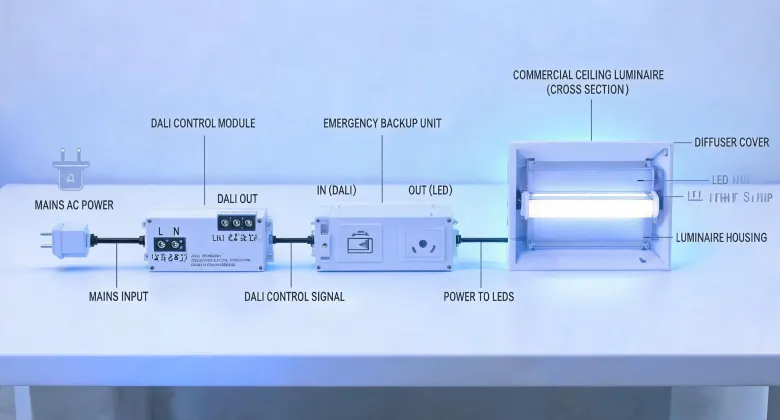
Here's the conclusion up front: if you're buying Samsung LED lighting for a commercial space, the product isn't the risk—the supply chain is. In late 2023, I spent six hours trying to source a Samsung LED 7020 6V module for a client whose ceiling was half open. The fixture itself was fine. The delay cost the client an extra night of overtime labor. That's when I stopped treating lighting as a shelf-pick and started treating it as a system.
In my role coordinating lighting procurement and emergency replacements for hotels, offices, and small venues, I've handled roughly 200 rush orders in the past four years. Most of them weren't caused by bad products. They were caused by wrong parts, vague specs, and a misunderstanding of what "in stock" actually meant.
Why I'm the person you want answering this
When I'm triaging an urgent order, I ask three things, in order:
- How much time do we actually have?
- Can the vendor prove this part will work with what's already installed?
- What's the worst-case scenario if it doesn't arrive on time?
That's it. Price doesn't even enter until those questions are answered. I've seen a $600 "rush order" fail because no one checked the driver voltage. I've also seen a $12 bracket save a $15,000 installation after someone pulled a cover off too hard and cracked the lens.
My experience is based on about 200 mid-sized commercial projects. If you're in luxury residential or very small one-off jobs, your risk points will be different. But in the B2B world, these patterns are remarkably consistent.
The counterintuitive part: urgent orders benefit from more process, not less
Here's the thing most people miss: when you're in a hurry, the temptation to skip verification is what causes the next emergency. Last quarter alone, I processed 47 rush requests. The ones that went smoothly had one thing in common—someone confirmed the part number, the physical dimensions, and the voltage before paying for shipping.
"In the middle of an emergency, the safe move is slow verification, then fast execution."
This matters specifically for Samsung LED parts. Samsung makes great LEDs, but the market is full of "compatible" modules and knockoffs. A Samsung LED 7020 6V module may look identical to a genuine version. If it's not matched to the driver or the thermal pad size, it can fail within weeks. I'm not saying no-name parts are always bad—I'm saying you shouldn't find out in a crisis.
What to know before ordering Samsung LED lighting products
As of January 2025, I still recommend checking Samsung's official product pages for updated part numbers before relying on a third-party listing. Samsung's partners change from region to region, and yesterday's catalog may not reflect today's inventory.
Downlights, spotlights, and standing lights: know the difference
Commercial lighting is more specific than "I need lights." A recessed downlight, a track spotlight mini, and a standing spotlight are all used for accent lighting, but they have different beam angles, mounting systems, and compatibility requirements.
- Downlight: Built into the ceiling, often with an IC-rated housing. Requires the driver to be accessible or replaceable.
- Spotlight mini: Small accent fixture on a track or surface mount. Great for displays, but the beam angle matters more than the wattage. You can't just swap in a different angle and expect the same look.
- Standing spotlight: Portable and easy to position, but you need to check cable quality and heat output. I've seen cheap standing spotlights melt their own plugs. (Surprise, surprise.)
Actually, that last one deserves more attention. In Q3 2024, I had a showroom client call because their standing spotlight started smoking during an event. The fixture was 15 minutes old. The cause wasn't the bulb—it was a crimped cord and a plastic socket that couldn't handle the heat. The vendor had only asked one question: "What color?" That's not enough.
Samsung LED display vs. Samsung LED lighting
Another common confusion: Samsung makes both LEDs for displays and LEDs for lighting. They're related, but not interchangeable. If a project spec says "monitor Samsung LED 22," don't assume it's a lighting fixture. It's a display product. It has a different warranty, a different power supply, and a different replacement path from a ceiling light.
That's not a problem until someone tries to solve a lighting failure with a monitor. An emergency lighting issue needs a lighting solution. A display issue needs an IT solution. Knowing which one you're dealing with can save you a day of wasted searching.
For urgent display replacements, I always ask: "Do we have a spare part or a spare unit?" In 2024, a client avoided a $1,000 service call because they had a spare 22-inch Samsung LED monitor in a storage closet. It wasn't the perfect model, but it kept the front desk alive until the real unit arrived.
The LED 7020 6V Samsung module question
If you're using fixtures that contain Samsung LED 7020 6V modules, keep a couple of spares on hand. This sounds obvious, but I've seen facilities with 200 fixtures and zero spare parts. When one fails, the whole room goes dark because they didn't know which module to order.
If a fixture calls for an "LED 7020 6V Samsung" module, don't substitute by guesswork. The package size, forward voltage, and connector type all need to match. A replacement LED 7020 6V Samsung module can be found, but the skill is knowing which one to choose.
Here's something vendors won't tell you: "in stock" often means "in the catalog." It doesn't mean "in the warehouse next door." If you need a replacement part in a hurry, ask if it can ship same-day from a physical location. That one question would have saved me a 3 a.m. airport pickup in my first year.
How to remove light cover from ceiling (without causing a new issue)
One of the most common "quick fixes" I get called for is a stuck light cover. Usually, the fixture is fine. The user just can't remove light cover from ceiling because there's a clip, a spring, or a safety screw they didn't see.
Here's a safe approach:
- Turn off the breaker. Not just the wall switch. Switches can be wired wrong, and the last thing you need is a live socket while your hand is in the ceiling.
- Look for screws or clips. Some covers twist counterclockwise. Some have spring-loaded clips that pull straight down. Some have a small notch for a flathead screwdriver. If there's a ring with a seam, it's probably a twist lock.
- Use a soft tool. A suction cup is great for flush glass covers. If you use a screwdriver, wrap the tip with tape. The goal is to avoid scratching the trim or cracking the glass.
- If it feels too tight, stop. A cover that won't budge might be painted over, glued, or sealed with a gasket. Forcing it can turn a 5-minute job into a fixture replacement. (In my first year, I made that classic mistake and cost a client a new ceiling tile.)
The quickest ceiling cover fix is the one that starts with checking for the obvious before applying force.
What you should actually stock
If you manage a commercial building, you don't need one of everything. Based on my repair history, these are the items that prevent 80% of emergency calls:
- A small box of compatible LED modules (including the Samsung LED 7020 6V if that's in your ceiling).
- One spare driver per fixture type.
- A standing spotlight or battery-powered emergency light for temporary coverage.
- A suction cup and a wrapped screwdriver for cover removal.
That's it. You're not building a lighting warehouse. You're buying time until the real fix happens.
When to ignore all of this advice
Look, I'm not going to pretend this advice works everywhere. If you're dealing with a sealed IP67 fixture, a security-rated light at a high ceiling, or a custom architectural installation, don't try the DIY route. And if you're working with a building that's newer than a year old, warranty support is your first move, not a third-party replacement.
Also, if you're sourcing for outdoor signage or road lighting, the suppliers are different, the compliance rules are different, and the stakes are higher. My experience doesn't cover those cases, so I'm not going to pretend it does.
What I can tell you is this: the pattern stays the same. Verify the part. Confirm the timeline. Have a spare. That's what separates a smooth project from an emergency call to someone like me.