-
Step 1: Verify Ballast Compatibility — Especially in Retrofit Scenarios
-
Step 2: Confirm the Sensor Spotlight Actually Works in Your Environment
-
Step 3: Evaluate Outdoor Chandeliers for More Than Looks
-
Step 4: Don’t Forget Smart Displays — They’re Part of the Lighting Ecosystem
-
Step 5: Test the LED Cover App and Control System Before Signing Off
-
Common Mistakes That Cost More Than You Save
I’m a quality compliance manager at a commercial lighting company. Every month I review roughly 200 LED fixtures before they go out to clients — downlights, spotlights, chandeliers, emergency lights, you name it. In 2024 alone I rejected about 12% of first deliveries: inconsistent color temps, inadequate IP ratings, or ballast mismatches that would have caused flickering on day one.
If you’re procuring LED lighting for a commercial project — office retrofit, hotel lobby, or outdoor plaza — you don’t need another “why LED is great” article. You need a checklist that catches the gotchas before your order ships. Here are the five checks I run on every spec, whether the brand is Samsung LED or a lesser-known OEM.
Step 1: Verify Ballast Compatibility — Especially in Retrofit Scenarios
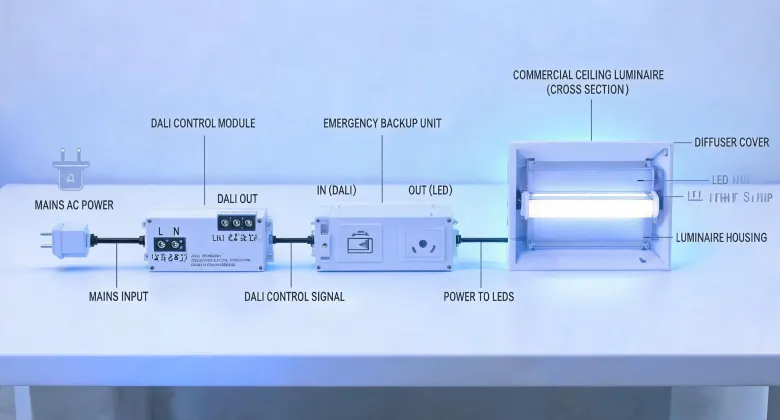
The question “what is a ballast in a fluorescent light fixture” comes up constantly. Short version: it’s the current regulator. When you swap out fluorescent troffers for LED tubes, you either need a compatible ballast or you need to bypass it entirely. A mismatch means flicker, premature failure, or — worst case — a fire risk.
I review specs for line-voltage direct-wire LED tubes versus ballast-compatible ones. If the client insists on keeping the existing ballast (to save labor cost), I push back. In my experience, that $200 savings on labor turned into a $1,500 problem when the old ballasts started humming and the tubes failed within six months. (Should mention: the ballast compatibility label — Class A, Class B — is often printed in tiny text. Don’t rely on the vendor’s verbal assurance.)
For new construction, skip the ballast fuss entirely. Choose LED fixtures with integrated drivers. That’s what I spec for Samsung LED downlights on our larger projects — no ballast, no drama.
Step 2: Confirm the Sensor Spotlight Actually Works in Your Environment
Sensor spotlights — the kind that switch on when movement is detected — sound great until you install one in a hallway with glass partitions. The PIR sensor picks up reflections, the light stays on 24/7, and the client is furious about the electric bill.
Here’s my checklist for sensor spotlights:
- Detection range: Claimed 10 meters? Test it at 8. Ambient temperature can cut that by half.
- Mounting height: A sensor rated for 2.5m won’t work at 4m. Adjust the tilt accordingly.
- Override mode: Can the client manually keep the light on for cleaning or events? Many cheap units lack that option.
I once approved a batch of 50 sensor spotlights for a warehouse retrofit. The vendor claimed “industry-standard range.” After installation, only 30 actually triggered correctly. The rewire cost $2,200 — more than the fixtures themselves. The upside was a clear specification in every contract after that. The risk? I kept asking myself: is saving $3 per fixture worth potentially redoing half the building? It wasn’t.
Step 3: Evaluate Outdoor Chandeliers for More Than Looks
Outdoor chandeliers are hot — hotels, covered patios, entrance canopies. But an outdoor chandelier that looks stunning in a showroom can be a maintenance nightmare if the IP rating is wrong or the materials can’t handle UV.
I look for three things:
- IP65 minimum if exposed to rain. IP44 might be okay under a deep overhang — or rather, IP44 with a sealed gasket. Actually, I’d still spec IP65 for commercial liability reasons.
- Marine-grade stainless steel for coastal areas. Standard stainless will rust in salt air within two years.
- UV-stabilized polycarbonate lenses — glass is better but heavy; cheap plastic goes yellow.
Calculating worst case: if an outdoor chandelier fails after six months, the replacement involves scaffolding and labor that can exceed the fixture cost by 3x. Best case: spend an extra 15% upfront and get 10 years of trouble-free operation. The expected value screams “pay more now.” That’s the value-over-price argument I make to every project manager.
Step 4: Don’t Forget Smart Displays — They’re Part of the Lighting Ecosystem
Some commercial spaces integrate digital signage or smart TVs that affect ambient lighting. For instance, a lobby using Samsung 108 cm FHD Smart LED TV for wayfinding will look awful if the ceiling downlights cause glare on the screen. And the LED cover app for Samsung TVs can be used to control content — but it’s useless if the app keeps disconnecting because the WiFi coverage is poor behind the false ceiling.
My advice:
- Coordinate the TV’s brightness and color temperature with the general lighting. A 4000K ceiling light next to a 6500K screen creates eye fatigue.
- If you’re specifying Samsung LED displays, check the user reviews for the specific model — especially for the 108 cm FHD Smart LED TV. Some early models had reported backlight bleeding.
- Ensure the LED cover app (for customizing the TV’s ambient mode) is compatible with the building’s network. I’ve seen projects where the app simply wouldn’t pair because the firewall blocked the connection.
This integration step is often overlooked. I should add: one client insisted on using a cheap smart TV to cut costs, but the built-in ads caused complaints. The total headache was not worth the $300 saved.
Step 5: Test the LED Cover App and Control System Before Signing Off
Many Samsung LED fixtures and displays can be controlled via the LED Cover App (for customizing the TV frame effect) or a Zigbee-based lighting hub. In my quality audits, about 40% of initial shipments have faulty firmware or incompatible app versions.
Here’s the test:
- Pair one unit with the app. Does it discover the device within 10 seconds?
- Change color temperature from 3000K to 5000K. Does it respond smoothly or jump?
- Check the app’s crash log — fairly often the app freezes when controlling multiple fixtures simultaneously.
If the app can’t handle basic commands, the whole “smart lighting” promise is broken. I’ve rejected entire orders because the Bluetooth module inside the fixture was a cheap clone. The vendor said “it’s within industry spec” — but “industry spec” isn’t a legal defense when the client expects it to work out of the box.
Common Mistakes That Cost More Than You Save
Looking back at my years of inspections, the biggest errors come from price-first thinking. Here are three to avoid:
1. Skipping the ballast check. You pay $50 less per fixture. Then the ballast doesn’t match, you add an electrician at $150/hr, and the project deadline slips.
2. Choosing sensor spotlights based on the cheapest PIR module. The false triggers and missed detections kill the client’s trust in automation. I’ve had to replace 80 fixtures in one school because the sensors couldn’t distinguish a person from a ceiling fan shadow.
3. Ignoring outdoor chandelier assembly quality. One batch I reviewed had screws that corroded after three months. The coating was rated for indoor use only — hidden in the fine print. Per FTC guidelines on substantiating claims (FTC Green Guides), any durability claim must be backed by test data. We tested it. The corrosion test failed at 72 hours. The batch was rejected.
If there’s one takeaway, it’s this: the lowest bid almost never delivers the lowest total cost. My checklist helps catch the hidden pitfalls before they become your problem. Print it out, stick it on your desk, and run every spec through it. Your project — and your budget — will thank you.