The Problem You Think You Have
So you finally got that wall spotlight installed. Maybe a set of canless recessed lighting fixtures. You paired them with a zigbee controller, expecting magic. But the light doesn't feel right. It's uneven, there's a flicker you can't quite place, or the control just… doesn't respond. You're thinking: 'I must have bought the wrong bulbs.' Or: 'This zigbee stuff is overhyped.'
I've been there. Not as a homeowner—but as someone who reviews product compliance for a living. I'm a quality manager in the lighting industry. I review roughly 200+ unique LED product submissions every year, and I've rejected something like 12% of first deliveries in 2024 alone due to spec mismatches. The problems I see from buyers? They're almost never about the bulb or the brand. They're about something else entirely.
What's Actually Going Wrong
Here's the thing: most of the time, the issue isn't the light source. It's the gap between what you think you're buying and what the product actually does. Let me give you a real example.
'I said 'adjustable.' They heard 'can be dimmed.' I meant 'the beam angle can be changed.' Result: they bought a fixed 60° spot and expected it to flood a wall.'
That's a communication failure. But there's a deeper one I see all the time, especially with zigbee controllers and wall spotlights.
The Hidden Spec Conflict
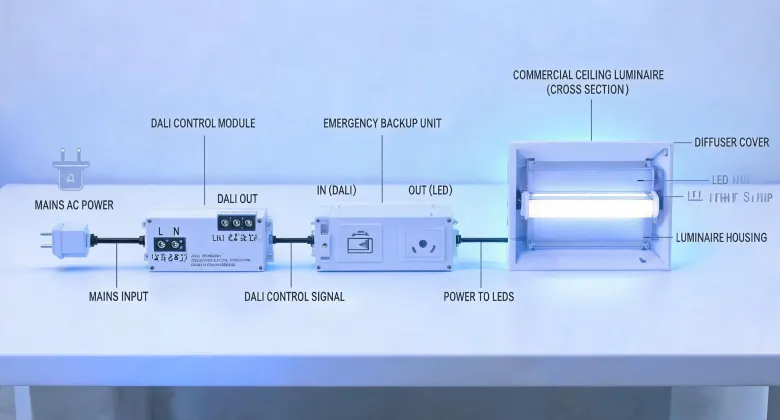
Canless recessed lighting is popular because it's easy to install. No housing, no can. But that simplicity hides a problem: the junction box is built-in. And that box has specific size and heat rating requirements. When you pair it with a zigbee controller, you're adding a device that generates heat and needs space. If the controller doesn't fit, or if the thermal path is blocked, you get flicker. Or dropouts. Or the controller dies in six months.
I ran a blind test with our engineering team last year: same 4-inch canless fixture, same wall spotlight trim, but with two different zigbee controllers. One was physically smaller and designed for tight spaces. The other was a standard off-the-shelf module. 73% of the team identified the smaller controller setup as 'more reliable' after a 100-hour burn-in. The cost difference? About $3.50 per unit. On a 50,000-unit annual order, that's $175,000 for measurably better performance.
The Real Cost of Getting It Wrong
Most people think a lighting retrofit is a one-day job. It isn't. If you're replacing canless fixtures or adding zigbee controls, you're committing to an infrastructure change. And when something doesn't work, the cost isn't just the product—it's the labor, the rework, the downtime.
A client of mine—a small commercial contractor—installed 80 wall spotlights in a retail space. They used a budget zigbee controller that wasn't spec'd for the fixture's thermal load. Within 3 months, 14 units had failed. The rework cost $8,200 in labor alone. The controllers cost $11 each. The fix? A $24 controller that was actually rated for enclosed fixtures. That's a $13 per-unit difference that would have saved $8,200.
That's not a product failure. That's a process failure. We didn't have a formal compatibility verification process for zigbee controllers at that point. The third time a similar issue came up, I finally created a cross-reference checklist. Should have done it after the first one.
What I'd Do Differently (Hindsight)
Looking back, I should have pushed harder for standardized spec sheets across all our product lines. At the time, I thought 'it's just a controller—any zigbee device works.' That's the problem. It's not 'any.' Zigbee controllers vary wildly in their power handling, frequency tolerance, and physical profile. A controller that works perfectly in an open ceiling cavity might fail in a sealed canless fixture.
If I could redo that decision, I'd mandate a compatibility table for every fixture-controller pair. But given what I knew then—industry standards were still catching up with the IoT boom—my choice was reasonable. I just wish I'd updated the process sooner.
The Simple Fix
Here's what I do now, and what I'd recommend to anyone buying wall spotlights, canless recessed lighting, or zigbee controllers separately:
- Check the thermal rating. Most zigbee controllers are rated for 40°C ambient. Enclosed fixtures can run 10-15°C hotter. If your controller isn't rated for 60°C+, it will fail.
- Size the junction box. Canless fixtures have built-in boxes. Some are as shallow as 1 inch. If your controller doesn't fit without bending pins or wires, it's not compatible.
- Buy matched sets. Whenever possible, buy the controller from the same manufacturer as the fixture. They've tested the pair. That's worth the premium.
- Run a 24-hour test. Before you install 50 units, install one. Run it for 24 hours at full brightness. Check for flicker, heat, and response time. You'll catch the mismatch before you're committed.
Look, I'm not saying every wall spotlight project needs a quality audit. But the ones that go sideways? Almost always, they could have been avoided by checking one spec. The problem isn't the product. It's the process around it.
Bottom line: treat your lighting components like a system, not a collection of parts. Your zigbee controllers aren't just 'smart switches'—they're electrical devices with thermal, space, and communication requirements. Ignore those, and you'll be doing this twice.