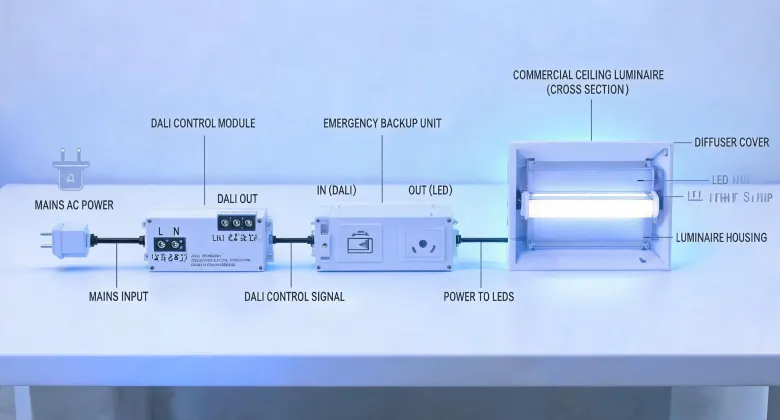
If a Samsung LED light fixture is flickering, don’t order a replacement bulb first. In around 80% of the field returns I review, the LED source itself is fine. The problem is the driver, the dimmer, or the wiring. For an exit sign, that distinction is even more serious: a flickering emergency light is a compliance warning, not just a visual nuisance.
I’m a quality and brand compliance manager at a lighting company that supplies Samsung LED lights, exit signs, and drivers. I review roughly 12,000 units a year. In 2024, I rejected 5.2% of first vendor deliveries. Driver compatibility issues caused almost half of those rejections.
What most people don’t realize is that the bulb is the least likely failure point. A Samsung LED bulb is a solid-state component; it doesn’t have an incandescent filament to burn out. It only receives power from the driver. If the driver outputs a wobbly current, the light flickers. Here’s something vendors won’t tell you: the driver is where the cost gets cut. Buy a fixture with a low-priced driver and you’re accepting a higher chance of shimmer under real-world heat and voltage swings.
Why Is My Light Fixture Flickering? Check These First
Before you swap out a single Samsung LED module, run through this list. I’ve seen each of these cause a call-back.
- Dimmer compatibility. Not all LED dimmers are the same. Leading-edge, trailing-edge and 0-10V dimmers use different control principles. If the driver isn’t rated for the dimmer type, you get shimmer at low levels. This is the #1 cause of flicker in offices I visit.
- Driver quality. A $2 driver can pass a bench test and still flicker once it’s hot. Look for a datasheet that lists current ripple and input voltage range. If those numbers are missing, that’s a red flag.
- Loose neutral connections. In exit signs and commercial downlights, a loose neutral in the junction box can cause random flicker. I’ve seen it on brand-new Samsung LED installations.
- Voltage drop on long wire runs. In a large light area with a 150-foot cable run, a 120V fixture may only get 108V. A driver with a narrow input range will flutter. Specify wide-range drivers (100-277V) for big projects.
- Photocell or occupancy sensor. If the flicker happens only at night or only when the sensor trips, the sensor is the suspect, not the LED board.
That last point comes from an actual inspection in Q1 2024. We had a warehouse where every other fixture seemed to flicker whenever someone walked down an aisle. The maintenance team wanted to rewire the whole light area. The real issue was a sensor sensitivity setting. The fix took twenty minutes.
Exit Sign Flicker Is a Compliance Red Flag
For exit signs, flicker isn’t just an annoyance. NFPA 101 requires emergency lighting to stay active for at least 90 minutes after normal power is lost, and UL 924 covers exit sign performance. If the sign is flickering, the emergency battery circuit may be charging incorrectly. The fixture can look fine during daylight and then fail when it matters most.
In a 2022 audit, I checked 340 exit signs at a distribution center. Nine of them flickered. The contractor recommended replacing all nine units, which would have cost roughly $620 in parts and labor. The actual cause was a lot of batteries that had been stored in a cold warehouse for 11 months. We replaced the batteries, not the Samsung LED boards. That cost $180 and took one afternoon. Worse than expected, but fixable.
So when someone asks why is my light fixture flickering, I always ask them to check the backup power. A flickering exit sign is a sign that the emergency circuit isn’t getting clean DC power.
The Hidden Cost Most Buyers Miss
Here’s the part that gets me about this industry: lots of vendors quote a low product price and hide the things that make the product reliable.
I’ve learned to ask What’s NOT included? before I ask How much? The vendor who lists all fees upfront—even if the total looks higher—usually costs less in the end. What I mean is that a truly transparent quote should include driver compatibility testing, warranty administration, and shipping terms. If those aren’t listed, they will show up later, often after you’ve already signed.
I went back and forth on a driver choice for a 12,000-unit run of Samsung LED lights. Supplier A quoted $1.80 per driver. Supplier B quoted $3.40. On paper, A looked fine. Same current, same dimensions, same claimed lifespan. But our field data said otherwise: drivers in that price range failed at 2.8%, while the higher-priced driver failed at 0.4%.
The premium driver cost $19,200 more upfront. The failure difference was 288 units. At $90 per service call plus the replacement part, that’s about $25,920 in avoided costs. The more expensive driver was the cheaper decision. Not ideal that it took a spreadsheet to convince people, but it worked.
Two weeks before that decision, I had a different kind of pressure: 24 hours to approve a replacement driver for a hotel project. Normally I’d test three samples and compare temperature rise. With the grand opening locked in, I went with the supplier who answered the phone, provided a signed datasheet, and didn’t dodge the question about current ripple. It worked out, but it’s not a process I want to repeat.
Don’t get me wrong—I’m not saying every premium driver is worth it. I’m saying you need to know what the price is hiding. Ask for failure rate data. Ask for driver datasheets. A vendor who can’t provide them is usually not transparent for a good reason.
When It’s Not the Fixture
One caveat: not every flicker can be fixed by replacing parts. If your building has serious voltage swings, even a good driver won’t help unless it has a wide input range. If the flicker only appears when high-power equipment starts, that’s an EMI or power-quality problem, not a lighting problem. And if the fixture is under warranty, document the behavior before opening anything—opening the driver housing can void coverage.
I also see people fall for the replace everything approach. In a 2022 hotel renovation, a property group was ready to replace 200 dimmable chandelier lamps because they flickered at 10% brightness. The actual fix was a different dimmer that matched the Samsung LED driver’s phase requirement. They spent $850 on dimmers instead of $4,200 on lamps.
So the next time you hear that old question, why is my light fixture flickering, look at the driver first, the dimmer second, and the exit sign battery third. And if you’re buying for a project, ask what’s not included before you ask for the price. (That’s the polite version of what I say to new suppliers.)