-
1. What exactly is iGuzzini, and why should distributors care?
-
2. What should I look for in architectural lighting OEM suppliers?
-
3. Recessed and linear — which spec details actually matter?
-
4. Chandelier catalogs — how do I evaluate a collection quickly?
-
5. What should I look for in a table lamp supplier?
-
6. What's changed in commercial lighting for 2025?
-
7. Emergency projects — can I expedite an iGuzzini order without breaking compliance?
These are the questions I actually get about iGuzzini architectural lighting — usually from someone with a spec package due, a client waiting, and not enough time to sort it out. No catalog tour. Straight answers.
1. What exactly is iGuzzini, and why should distributors care?
iGuzzini is an Italian architectural lighting brand that covers the main categories — linear, track, recessed, pendant, ceiling, wall, floor. For distributors, that's a big deal on the procurement side: one spec line, one catalog, one support channel to manage.
But here's the catch. "Full portfolio" doesn't mean "fits every application." I've watched buyers flip to the back of the catalog, pick the cheapest option, and then discover it doesn't meet the glare or IP requirements for their project. The portfolio is broad, but you still need to match the right family to the application.
As of late 2024, spec support was solid, but distributor terms vary a lot by region. Confirm local stock before you promise a date — I learned that one in 2023 when "regional warehouse" turned out to mean "still in Italy." So glad I double-checked before promising a delivery date. Almost committed to a two-week timeline that would have turned into six.
2. What should I look for in architectural lighting OEM suppliers?
The thing that matters with architectural lighting OEM isn't the parts — it's consistency. Will that recessed downlight still match the rest of the batch after five runs? Will the dimming curve hold?
Three things I check every time:
- Batch consistency data. Not just a CRI number — the actual CCT tolerance they hold.
- Compliance documentation. An actual test report, not a claim that one exists.
- Spec change communication. How fast do they flag product updates before your spec is outdated?
(Should mention: I also order a sample batch before committing — but that's so standard now I almost forget to say it.)
What's interesting — I was evaluating OEM suppliers on a totally different set of criteria in 2020. Price and lead time mostly. That's changed. Controls compatibility now matters as much as optics.
Bottom line: if the supplier can't show you test data, you're in a price conversation. And a price conversation means you're carrying the compliance risk.
3. Recessed and linear — which spec details actually matter?
For recessed: beam angle consistency, not just CRI. A spec sheet says CRI 90 and the beam is wide and mushy — so the wall wash that was supposed to have focus just becomes flat spill.
For linear: look at the connection method and end-cap finishing. I've seen projects delayed because the end caps didn't match the ceiling color. Dumb problem, real delay.
One thing most people don't ask about: lumen maintenance. Everyone checks LM-80 data, but nobody matches it to the actual operating temperature. If the fixture runs at 700mA and the LM-80 report is at 500mA, the report doesn't mean much.
We lost three days on a project in Q1 2024 because of this. So glad our PM caught the output gap before the punch walk — one more week and it would have been a post-install fix.
4. Chandelier catalogs — how do I evaluate a collection quickly?
Chandeliers are where specs go wrong the most. The catalog looks beautiful. Then you realize the decorative piece is project-specific and has a 14-week lead time.
What I look for:
- Mounting points noted in the catalog — some families need structural support that the architect didn't account for.
- Field-replaceable LED modules vs. factory-sealed. Field-replaceable saves a ton of hassle later.
- Weight and packing — oversize shipping gets ridiculous (we paid $800 in extra freight — call it $900 after the fuel surcharge — but saved a $12,000 project).
Also: check whether catalog price includes suspension kit. Some brands quote them separately and it blows a hole in the budget.
5. What should I look for in a table lamp supplier?
Table lamps aren't the same as architectural fixtures — but the spec discipline is the same.
What I check:
- Switch and plug type. Does it match the destination market? EU plug on a US project is a return.
- In-line components — socket, switch, wire gauge. Not visible, but they decide whether the lamp passes inspection.
- Sample policy. If the supplier won't let you see a sample under multiple room temperatures, that's a red flag.
Most buyers I know screw this up by focusing on the shade or base. They should be looking at the power supply. Cheap LED drivers whine when you dim them — customers don't complain about light quality, they complain about noise.
We learned this in 2022. Ordered 40 table lamps, half of them whined on site. The vendor swapped them, but we lost two months of on-site time.
6. What's changed in commercial lighting for 2025?
Two things, and both matter:
Compliance. Energy codes are moving faster. California Title 24 was updated in 2022 to emphasize controlled receptacles and tunable-white capability beyond basic efficacy. If you're specifying against the 2019 code, you may already be behind. The DLC's technical requirements also keep tightening criteria for networked controls.
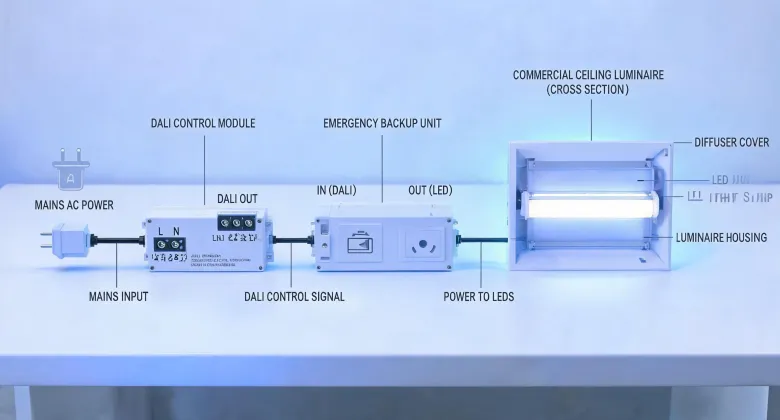
Control integration. Tunable white and networked controls in 2025 are in a different league than a few years ago. DALI-2, wireless mesh, PoE — the portfolio needs to cover these or the distributor ends up doing integrator work on spec.
That's a bit counterintuitive for some people: lighting product specs are starting to look like control specs. If the supplier isn't solid there, the spec package won't hold.
The basics haven't changed — reliable light output, solid compliance files, predictable lead times. The execution has transformed. Five years ago, control integration was optional. Now it's table stakes in commercial projects.
7. Emergency projects — can I expedite an iGuzzini order without breaking compliance?
Yes, but it costs and needs planning. I learned this the hard way.
First: confirm what "in stock" actually means. Does it mean "in the regional warehouse, ready to ship" or "in production, 6 weeks out"? I've been burned assuming the first when it was the second.
Second: ask what can ship and what can't. Sometimes the brand can ship core fixtures but dimming modules are back-ordered. That's a partial delivery that can hold up the whole install.
Third: don't skip the quality check. It's tempting on a rush job to skip final inspection and end up with the wrong color temperature. We had a project last week — 12 recessed downlights, 3 of them were 4000K with a green tint. Fixing it took three days.
One mitigation trick: if the supplier has multiple stock points, ask about split shipments. Usually it's "no" — but it's worth asking. Last time I asked, it saved two weeks.