-
Who this checklist is for
-
Step 1: Read the spec sheet before the price sheet
-
Step 2: Force the vendor to price the accessories separately
-
Step 3: On displays, confirm the panel generation in writing
-
Step 4: Verify the control protocol — actually verify it
-
Step 5: Define "consumable" in the warranty
-
Step 6: Run your own TCO — don't trust theirs
-
Step 7: Do a real pilot, not a sample
-
Common mistakes I've seen (and made)
Who this checklist is for
If you're the person at your company signing off on lighting or LED display purchases — downlights for a retrofit, pro spotlights for a retail floor, a bar chandelier for a hotel lobby, or a 40-inch Samsung LED smart TV for the front desk — this is written for you. I run procurement for a mid-size property group managing six office buildings and two exhibition halls. My lighting and display budget runs around $1.8M annually, and I've negotiated with 40+ vendors over the past six years while logging every PO in our cost tracking system.
Below are the seven steps I run before any PO goes out. Each one has a checkpoint, so you can stop at any step and know whether the quote in front of you is actually competitive or just looks that way.
Step 1: Read the spec sheet before the price sheet
I only believed this rule after ignoring it once. In early 2023, I approved a batch of 200 downlights based on unit price alone. Skipped the spec sheet. Turned out the drivers weren't on the DLC qualified list, which meant our client's utility rebate fell through — about $800 we ate out of the project budget. It's a boring step. Do it anyway.
Checkpoint: Before you compare prices, put every quote in the same column format: lumens, CCT, CRI, wattage, driver brand, dimming type, and certifications. If a vendor can't put those in writing, that's your answer.
Step 2: Force the vendor to price the accessories separately
This is the step most buyers skip, and it's the one that bites hardest. Any commercial spotlight quote you get is going to include the fixture, but not always the mounting kit — track adapters, ceiling springs, and what everyone in the trade calls spotlight snaps (the twist-lock clips that hold a fixture into a ceiling cutout or track). On a 400-unit order, snaps at $0.80 each versus $2.10 each is a $520 swing that never shows up on the headline price.
Same thing on the high end. When I priced a bar chandelier for one of our hotel lobbies, two vendors quoted within 6% of each other on the fixture itself. One quoted the suspension kit as "included." The other added $1,340 for the stem and canopy set on the invoice. Not hidden, exactly — just not on page one.
Checkpoint: Ask for a line-item breakdown that separates fixture, drivers, mounting hardware, connectors, and freight. Anything bundled should be flagged.
Step 3: On displays, confirm the panel generation in writing
If you're sourcing something like a Samsung transparent micro LED unit, or even a 40-inch Samsung LED smart TV for a waiting area, the model number alone doesn't tell you what you're getting. Panel generations turn over fast. A supplier quoting "the same model" as last year may be clearing older inventory, and the samsung transparent micro led price you saw online three months ago often reflects whichever generation was current then (circa early 2025, that pricing moved weekly).
From the outside, two displays with the same model designation look identical. The reality is that generation, firmware, and regional variant all affect warranty coverage — and the price delta can be 20%+ for essentially the same-looking unit.
Checkpoint: Ask for the full SKU, panel generation, and firmware version in writing before you sign. If they can't confirm it, that quote goes in the maybe pile, not the yes pile.
Step 4: Verify the control protocol — actually verify it
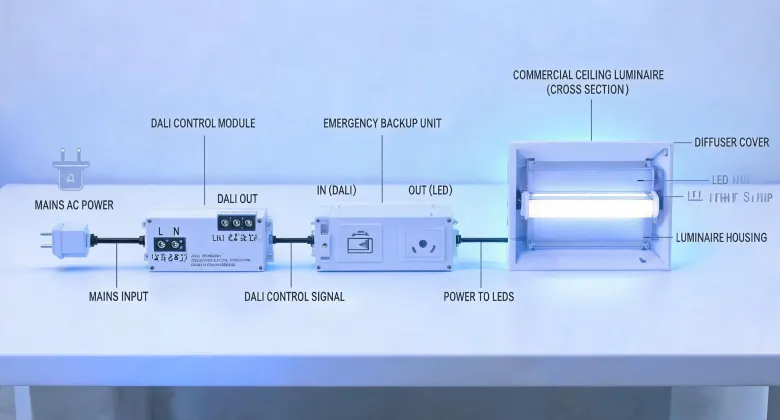
"Zigbee compatible" and "works with Zigbee" are not the same sentence. Neither is "DALI ready." I've watched a facilities team install 80 fixtures across two floors before discovering the gateway wouldn't talk to the drivers we bought. Rewiring cost us $4,700 and three days of downtime.
Checkpoint: Get the exact driver model and its interoperability certification in writing. Then have your IT or BMS person confirm it on paper before you approve the PO.
Step 5: Define "consumable" in the warranty
Every manufacturer excludes consumables. Very few define what that word means. Drivers, LED boards, and sometimes even the module inside a fixture get classified as consumables, which is how a "5-year warranty" turns into 14 months of real coverage.
I now require the warranty clause to list every excluded component by name. If the vendor pushes back, that tells me more than the warranty document did.
Checkpoint: Ask for the warranty exclusion list in writing, and get the name of the parts distributor who stocks replacements.
Step 6: Run your own TCO — don't trust theirs
Vendors hand you a TCO spreadsheet the way they want you to see it. Build your own. Mine has four columns beyond unit price: replacement rate based on past orders, freight, installation labor delta, and disposal.
Here's where gut and data fight. Last year, my spreadsheet said go with Vendor B — 15% cheaper on fixtures with comparable spec sheets. My gut said stay with Vendor A, the incumbent. I went with the spreadsheet. Within eight months, B's failure rate was 3x higher on the first 200 units, and I was fielding redo requests I hadn't budgeted for.
Checkpoint: Before finalizing, call whoever installed your last similar order and ask what actually broke. That number goes in your TCO, not in the vendor's.
Step 7: Do a real pilot, not a sample
A sample fixture that ships in a box is not a pilot. A pilot is 10–20 units installed on an actual circuit, running for at least 30 days, with someone who'll actually notice if performance drifts.
Checkpoint: Document the pilot's baseline metrics (lumens, CCT, driver temp) on install day and re-measure at day 30. If the vendor won't support a 30-day pilot, they're telling you something.
Common mistakes I've seen (and made)
- Chasing the lowest quote. In my experience, the lowest quote has ended up costing more than the middle quote in about 60% of the cases I've tracked. Usually through freight, hardware, or a failure and redo.
- Approving off a PDF. Spec sheets lie less than sales reps, but not by much. Ask for the actual test report, not the summary table.
- Skipping the utility rebate check. DLC or Energy Star listings aren't glamorous, but they're real money. Check before you commit.
- Ignoring lead time. I've seen a "cheaper" vendor add six weeks of lead time, which pushed a project past its move-in date and cost us a $2,400 penalty.
One more thing worth mentioning: per FTC advertising guidance (ftc.gov), any performance claim — including energy savings percentages or "latest generation" labels on displays — has to be substantiated. If a vendor can't back the number, that isn't a negotiation tactic. That's a warning sign.
Run the seven steps. It takes an extra afternoon. It's saved me more than one expensive afternoon since.