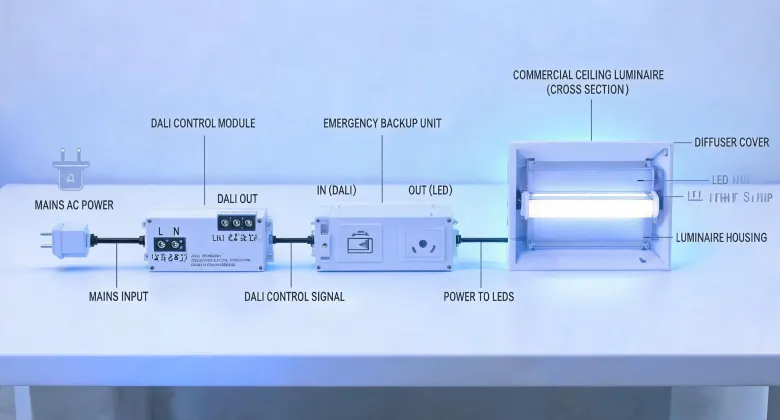
I manage procurement for a mid-size company with pretty varied spaces—a 6,000 sq ft warehouse, a customer-facing lobby with an outdoor courtyard, and a set of conference rooms. In 2024, I got approval to upgrade lighting and displays across all three. Same capital budget, same vendor portal, same approval chain. But the right answer for each space couldn't have been more different.
This piece is for anyone stuck on "what should I buy?" for commercial lighting or displays. Instead of giving you one universal recommendation, I'm going to walk through three scenarios I've actually dealt with. Find yours, and the advice might save you some backtracking.
Scenario A: You're Lighting a High-Ceiling Space
This is the high bay vs low bay lights question. General rule of thumb: ceilings above 20 feet usually call for high bay fixtures. Below 15 feet, low bay. In between, it depends on your layout.
But here's what I learned the hard way—the ceiling height matters less than beam angle and fixture spacing. We initially ordered high bay lights for our warehouse based purely on height, and half the floor still had shadowy patches near the racking.
Everything I'd read said higher wattage means better coverage for tall spaces. In practice, we got better results from more fixtures at lower wattage with the right optics. Fewer hot spots, less wasted light, and the electrician's labor cost actually went down because we didn't need dedicated high-voltage circuits.
What most guides don't mention: maintenance access matters as much as light output. If your fixtures are 30 feet up, you want something rated for 50,000+ hours. Otherwise you're paying for a lift rental every time a driver fails. That line item alone can double your five-year cost.
When high bay isn't right: If your space has frequent layout changes—movable racks, seasonal floor plans—fixed high bay fixtures become a liability. You'll spend more on re-aiming and re-circuiting than you saved on the original install. Consider linear high bays or even a layered approach with lower fixtures instead.
Scenario B: You Need Statement Lighting for an Outdoor or Feature Space
Different scenario, totally different priorities. Our lobby courtyard needed something visible from the street—durable enough for year-round weather, but not absurdly expensive to maintain.
Outdoor chandeliers are a different beast from indoor ones. The IP rating matters more than the design. IP65 should be your minimum for exposed outdoor use; IP44 will fail in driving rain. We learned this when our first pick—beautiful, but only IP44—started showing rust at the mounting points after one winter.
Color chandeliers are a separate consideration entirely. If you want colored light fill or RGB flexibility, you're looking at LED modules rather than traditional bulbs. That's actually simpler from a procurement standpoint because you specify the color temperature at order time rather than swapping bulbs later.
Here's something vendors won't tell you: "outdoor-rated" doesn't automatically mean frost-proof or wind-rated. We had to check the wind load rating for our specific area. A chandelier that's fine in a covered atrium might not survive rooftop exposure. Ask for the wind rating in writing—that conversation separates serious suppliers from catalog resellers.
When a decorative outdoor chandelier isn't right: If your space has high foot traffic or potential vandalism, an ornate chandelier becomes a liability. You'll spend more on repairs than the fixture is worth. In those cases, recessed or flush-mount outdoor-rated fixtures make more sense—less drama, but fewer headaches.
Scenario C: You're Buying Displays or TVs for Commercial Use
Third scenario: we needed displays for three conference rooms and a digital signage setup at the entrance. I assumed "LED TV" meant the same thing across brands and use cases. It doesn't.
Samsung LED displays come in a few distinct families. The consumer line—like the Samsung DU7175 4K LED Smart TV—works well for meeting rooms where you need a standard smart TV with app support, screen mirroring, and a familiar interface. The commercial signage line is a different product with different warranties and longer rated running hours.
Samsung LED TV price varies a lot depending on which category you're buying. Consumer models are priced for home use; commercial displays carry a premium but come with 16/7 or 24/7 rated operation. For a conference room that runs 8 hours a day, the consumer model is probably fine. For lobby signage running 12+ hours, you want the commercial-rated panel.
I assumed "same resolution" meant identical performance across panels. Didn't verify. Turned out the brightness rating (nits) matters far more than resolution for a lobby display with windows nearby. A 4K panel at 250 nits looks washed out in daylight; the same resolution at 500 nits reads clearly. Cost difference was maybe 20%, but the usability gap was huge.
According to Samsung's official product pages (samsung.com), the DU7175 falls under their consumer smart TV lineup, while their commercial displays are listed separately under Samsung Business. That distinction matters when you're filing warranty claims or comparing specs.
When a consumer TV isn't right: If your screen runs more than 10 hours a day or needs to display static content for long periods—like menu boards or wayfinding—a consumer panel will burn in faster and void its warranty. Commercial displays cost more upfront but last longer under those conditions. For a standard meeting room, save the money and buy consumer.
How to Figure Out Which Scenario You're In
Start with the constraints, not the product.
- Ceiling above 20 feet? You're in high bay lighting territory. Get the beam angle specs before you get the wattage.
- Will the light be visible from outside the building? Go outdoor-rated and check the IP rating plus wind load.
- Will the screen run more than 10 hours a day? Commercial display, not consumer TV. The warranty alone justifies the premium.
But those are just starting points. The real question is: what does failure look like in your context?
A flickering high bay fixture in a warehouse is an inconvenience. A rusted outdoor chandelier at your entrance is a visible embarrassment to every client who walks in. A conference room TV that dies mid-presentation costs you a meeting.
Prioritize the failure mode that hurts most, and spend your budget there. That's the whole framework. Three spaces, three different answers—but the same underlying logic.
After five years of managing these purchases, I've come to believe that the "best" product is almost entirely context-dependent. What works brilliantly in one space can be a waste of money in another. The skill isn't knowing which product is superior. It's knowing which product is right for your specific situation—and being honest enough to admit when what you're looking at doesn't fit.