The Two Most Commonly Confused Fixtures
If you're specifying LED lighting for a commercial project—a retail space, an office, or even a warehouse—you've probably stared at a spec sheet trying to decide between a spotlight and a downlight. They look similar in a catalog. Both can be recessed. Both can be surface-mounted. But they do different things, and picking the wrong one can cost you in performance, rework, or both.
My name's not important, but my job is: I'm a quality and brand compliance manager at a lighting company. I review every fixture that leaves our facility before it hits a customer's loading dock—roughly 200 unique SKUs annually. I've rejected about 8% of first-article samples in 2024 so far for beam angle inconsistencies, color drift, or driver issues. So when I say that spotlights and downlights aren't interchangeable, I'm not just repeating marketing copy. I've seen the purchase orders that prove it.
Here's the breakdown: a downlight is a flood fixture. It throws light in a wide cone—usually 60° or wider—to wash a room in general illumination. A spotlight is a narrow-beam fixture, typically 15° to 40°, designed to highlight an object or area. That's the basic difference. But the real-world implications go further: beam uniformity, glare control, energy distribution, and total installed cost.
Let's compare them across the dimensions that actually matter for a project.
Beam Control and Light Distribution
Downlight: Wide Wash, Even Coverage
A standard commercial LED downlight with a 90° beam spreads light across a large circle. If you're illuminating an open-plan office or a hotel corridor, that's perfect. You get even footcandles across the floor without harsh shadows. The trade-off? It's hard to make a downlight accent something specific. The light hits everything in its path equally.
Spotlight: Focused, Adjustable
An LED spotlight, especially one with a 20° to 30° beam, can hit a single product on a shelf or a sign on a wall. Many of the higher-end models in our lineup include adjustable tilt and rotation. That's a big deal for retail displays. But you lose the softness—spotlights create hard shadows and distinct hot spots. That's the feature, not a bug, if you want drama. But it's a problem if you're expecting ambient light.
"In our Q1 2024 audit of a retail fit-out, the spec sheet called for downlights throughout the sales floor. The contractor substituted spotlights in three zones 'to save money.' The result? The accent lighting looked great, but customers complained the changing rooms felt 'like an interrogation room.' We had to replace six fixtures—at the contractor's cost."
Quick conclusion: Use a downlight for general illumination. Use a spotlight if you need to point the light at something specific. Trying to make one do the other's job never works the way you'd hope.
Glare and Visual Comfort
This is the dimension where most buyers make a mistake, especially when they try to replace recessed lighting with flush mount lighting. The premise seems logical: a flush mount is simpler to install, and it might save ceiling height. But glare is the hidden cost.
Downlights with Reflectors
A quality downlight has a baffle or reflector to control glare. The light source is recessed into the ceiling, so it can't be seen from normal viewing angles. That's why downlights can use higher-wattage LEDs without creating discomfort—the fixture hides the source. In our tests, a 30W downlight with a 90° beam and a black baffle produces less perceived glare than a 15W spotlight with no baffle, even if the total lumens are similar.
Spotlights: Unshielded Sources
Most LED spotlights don't have deep reflectors. The diode is close to the lens surface. When you look at a spotlight from an angle—say, while sitting at a desk under it—you're staring at a bright point. That's a problem in offices, libraries, or any space where people look up. Industry standard luminance limits for indoor spaces are around 2000 cd/m² for direct view. A cheap spotlight can hit 5000+ cd/m². Honestly, that's not just uncomfortable—it's a safety risk if it causes glare-driven accidents in a warehouse setting.
Quick conclusion: If your project involves people looking at ceiling fixtures (which most occupied spaces do), consider a downlight with a proper baffle. Reserve spotlights for areas where the fixture is out of direct sight lines—above shelves, pointing at a wall, or in high-bay ceilings.
Energy Use and Lumen Efficiency
This is where the 'value over price' argument really hits home. A lot of buyers look at the wattage spec and assume a spotlight is more efficient because it uses fewer watts. But that's not how lighting works. Efficiency is about getting the right light where it's needed.
Field Efficiency vs. Lab Efficiency
In a lab test, an LED downlight and an LED spotlight of the same wattage produce similar lumens. But in a real room, the downlight spreads those lumens across a 12-foot diameter circle. The spotlight concentrates them into a 4-foot circle. If you need to light that entire 12-foot area, you'd need nine spotlights to equal one downlight's coverage. Suddenly, that 'efficient' spotlight is consuming 9x the power.
I ran a calculation for a 2,000 sq ft retail floor last quarter. The client wanted accent lighting for their product displays—fair enough. But they also wanted ambient light from the same fixtures. The result was a hybrid layout: 30 downlights for general illumination, plus 15 spotlights on gimbals for the high-value merchandise. The downlights delivered 70% of the usable light for 50% of the fixture count. That's not an opinion—that's arithmetic.
Driver and Dimming Compatibility
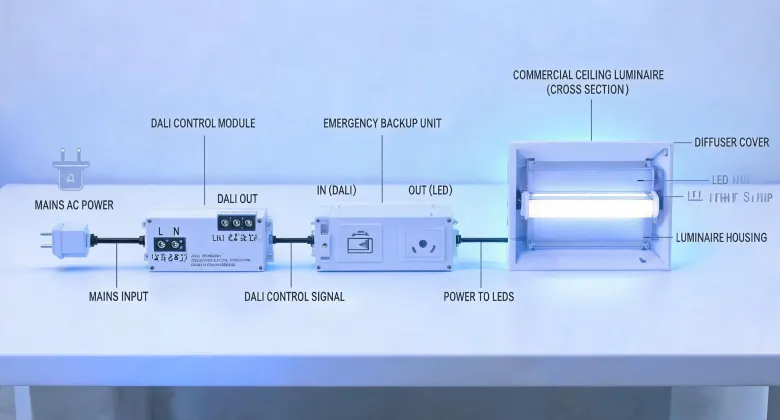
Not all spotlights use the same drivers. We've seen projects where the spec called for Zigbee-compatible drivers for smart lighting control, but the contractor bought basic spotlights with 0-10V drivers. It's not that 0-10V is bad—I actually prefer it for reliability in some settings. But if the building automation system expects Zigbee, and the fixtures don't have it, the whole control scheme breaks. Replacing those drivers after installation? That's a $35/unit labor cost plus the $8 driver. On a 200-unit order, that's an $8,600 mistake.
Quick conclusion: Don't compare spotlights and downlights on wattage alone. Compare them on delivered lumens per square foot for the intended use. And don't forget the driver and control compatibility—that's where the hidden costs live.
Installation and Compatibility: The 'Replacing Recessed' Dilemma
A lot of the questions I get from commercial buyers boil down to: "How do I replace recessed lighting with flush mount lighting?" Or the reverse. It shows up in the keywords people search for, and it's a real pain point. The short answer: it depends on the housing.
New Construction vs. Remodel
In new construction, you choose the housing for the fixture type. Downlights use standard 6-inch or 4-inch round housings. Spotlights often use a smaller round housing or a square box if they include a transformer for track-style setups. If you're going flush mount—meaning the fixture sits against the ceiling surface—you need a junction box that's rated for the fixture weight. A heavy spotlight with a transformer might need a fan-rated box, not a standard light box.
For retrofit: replacing an existing downlight with a flush mount spotlight usually works, because most downlights are already mounted on a junction box. But I've seen cases where the junction box is buried in insulation and the spotlight's mounting bracket can't reach. Not the end of the world, but it's an extra 45 minutes per fixture for the electrician. On a 50-fixture install, that's 37.5 hours of labor you didn't plan for.
The 'Samsung LED' Factor
If you're specifying Samsung LED panels or modules—whether for the lighting itself or for a Samsung 50-inch Micro LED TV in a lobby—installation tolerances matter. Our LED modules have a specific cutout size requirement. If the crew cuts a downlight-sized hole for a spotlight housing by accident, the fit isn't just ugly; it can create thermal issues. LEDs fail faster when they run hot, and a poorly-seated module creates a hot spot. We track these failure rates. A properly installed module in our samsung-led downlight line has a projected L70 life of over 50,000 hours. A module that's pinched or misaligned? That drops to under 30,000 in our temperature chamber tests.
Quick conclusion: If you're converting from one fixture type to another, factor in the labor for housing modifications. And if the fixture uses Samsung LED modules, follow the cutout specs to the letter. It's not just about the warranty—it's about the fixture lasting long enough to justify the upfront investment.
So Which One Do You Pick?
I usually give clients three scenarios. They're not exhaustive, but they cover the majority of commercial jobs I've reviewed.
Scenario A: Open Office or Classroom
Pick downlights. 90° to 120° beam, 3000K to 4000K CCT, with a matte or black baffle to control glare. Uniform footcandles across the whole space. Skip the spotlights unless you have accent walls.
Scenario B: Retail Showroom or Gallery
Go hybrid. Downlights for general wash (60-70% of fixtures), spotlights for product highlights (30-40%). Make sure the spotlights are dimmable and, ideally, on a Zigbee or DALI controller for scene setting. That way you can change the ambiance during sales events.
Scenario C: Warehouse or Utility Space
It depends on the ceiling height. Low ceiling (8-12 feet): downlights with a wide beam. High ceiling (15+ feet): spotlights with 30° to 40° beam can get light to the floor effectively. But use high-bay fixtures designed for that purpose—don't just point a standard spotlight downward. The glare will be awful for anyone on a forklift.
The bottom line? There's no universal right answer. But there are wrong answers, and most of them come from treating a spotlight and a downlight as if they're the same thing. They're not. Specify them for their strengths, and your project will look better, cost less over its lifespan, and pass inspection without rework.
That's my experience, anyway. I've seen enough Purchase Orders to know that a little thought upfront saves a lot of regret later.