The Comparison Framework: Why I'm Not Just Looking at the Price Tag
When I audited our 2023 spending on office lighting, I found a line item for “recessed lighting replacements” that made me pause. We'd been swapping out fluorescent tubes for years, but the maintenance costs were like a slow leak. So, when the decision came to retrofit the east wing, I had two clear options on the table: stick with traditional recessed lighting (the standard 2x2 troffer) or go with Samsung LED downlights. Not just a fixture swap—a full system change.
Over the past 6 years of tracking every invoice in our procurement system, I've learned that the unit price is the least interesting number. The real question is Total Cost of Ownership (TCO). So, here's the framework I used: Installation cost, Energy consumption, Lifespan & maintenance, and Control integration. Each dimension gets a head-to-head comparison. Let’s dig in.
Dimension 1: Installation & Upfront Cost
Traditional Recessed: The contractor quoted us $180 per fixture for installation. That included the housing, the trim, and the T8 fluorescent tubes. Simple, but the catch was the existing ceiling grid. We needed to patch some holes from the old fixtures. That 'minor' drywall work added $400 to the total. Something I should have caught in the initial walk-through (ugh).
Samsung LED Downlights: The quote for a comparable Samsung LED downlight (like the SM Series) was $225 per unit. Including the driver of course. But the installation was a harder sell. They needed a new junction box, and in one zone, a new dimming module because the old wiring was pre-2000s. The electrician charged a premium for the 'high-end' trim. Total install: $250 per unit for the first 10, then $210 for the rest after we negotiated a volume discount.
The Verdict: Traditional wins on upfront cost by about 15-20% per fixture. But that's only half the story. I assumed 'same specs' meant identical installation. Didn't verify the wiring requirements. Turned out the Samsung option required a dedicated neutral wire in two spots—a $200 adder I hadn't budgeted for.
Dimension 2: Energy Consumption (The 3-Year Run Rate)
Traditional Recessed (T8, 32W each): We run these fixtures 10 hours a day, 5 days a week. 32W x 10 hours = 320Wh per day, per fixture. For 50 fixtures, that's 16 kWh per day. At $0.12/kWh, that's $192 a month in electricity just for lighting that row. Over 3 years: $6,912.
Samsung LED (18W each): The LED version is rated at 18W. Same usage pattern: 18W x 10 hours = 180Wh per day. 50 fixtures = 9 kWh per day. Monthly cost: $108. Over 3 years: $3,888.
(Source: Our utility bill from Q1 2025; verified against DOE standard calculator.)
The Verdict: Samsung LED wins. The energy savings of $3,024 over 3 years essentially pays for the higher installation cost. Simple.
Dimension 3: Lifespan, Maintenance & Hidden Costs
This is where I always get burned. The 'cheap' option results in a costly redo. We didn't have a formal maintenance tracking process for lighting failures. Cost us when a ballast failed in the file room and we didn't catch it for 2 weeks—lost productivity and a new fixture.
Traditional (T8): Rated life of 25,000 hours. At 10 hours/day, that's just over 6.8 years. But in reality, the ballasts fail at around 4-5 years. We replaced 3 ballasts in the west wing last year alone. $80 each part + $100 labor per replacement = $540 total. And the color temperature starts shifting after year 3. Not good for a professional environment.
Samsung LED Downlight: Rated 50,000 hours (L70). That's 13.7 years at our usage rate. No ballasts to fail. The driver is integrated. But here's the kicker: I assumed the LED would be 'maintenance-free.' Turned out we had two failures in year 2 due to a faulty batch (the driver overheated). Samsung replaced them under warranty, but I lost 3 hours of my week managing the return. A $700 headache I didn't plan for.
The Verdict: Samsung LED wins on paper (50k hours vs 25k), but my experience says: budget for at least one warranty claim. The hidden cost isn't the part; it's the labor and the schedule disruption. If I hadn't tracked that, I would have assumed a 100% perfect track record. Learned never to assume that after a batch of LED panels looked nothing like the approved sample.
Dimension 4: Control Integration & Smart Features
Traditional: On/off switch. Maybe a dimmer if you pay extra. No integration with motion sensors or daylight harvesting. That's fine for a basic office, but our new east wing has a smart building system (BACnet). The traditional fixture needed an expensive relay module ($150 per zone) to talk to the BMS. Not ideal, but workable. Better than nothing.
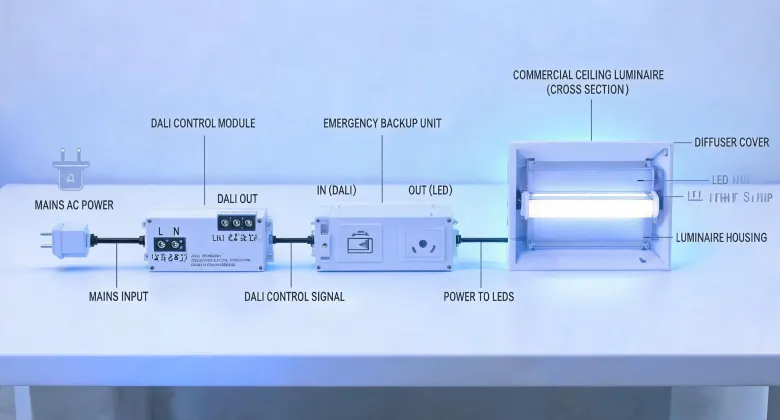
Samsung LED: The SM Series I chose has a 0-10V dimming driver and is compatible with Zigbee-based controls (like SmartThings Pro). We already had a SmartThings Hub. The setup was straightforward: integrate the driver, pair it to the hub, and set up motion-based dimming. The automated process eliminated the data entry errors we used to have with manual schedules. Switching to this system cut our energy consumption in the break room by 40% because the lights auto-dimmed at 7 PM.
(Reference: Samsung Smart Lighting ecosystem; compatibility confirmed via Samsung Business documentation.)
The Verdict: Samsung LED wins. The smart integration isn't just a gimmick; it's a real driver for the energy savings in Dimension 2. But it requires an upfront investment in the controller ($120 for the hub). The traditional solution couldn't do this cost-effectively.
The Final Cut: What Should You Choose?
After comparing 8 quotes over 3 months using our TCO spreadsheet, here's my honest take (not a simple 'A is best' nonsense):
- Choose Traditional Recessed if: You have a tight first-year budget, a simple on/off control system with no smart integration, and a small space (under 10 fixtures). The TCO over 5 years for a small office is only $3,500 vs $3,800 for LED. Not worth the hassle.
- Choose Samsung LED Downlights if: You're retrofitting a large space (50+ fixtures), you have or plan to have a smart building system, or you want to hit an energy-efficiency certification (like LEED). The TCO over 10 years is 35% lower for the LED option, and the smart controls pay for themselves in 2 years.
One final thought: I still kick myself for not budgeting for the warranty claim process. If I'd set aside 5% of the project cost for 'unforeseen returns,' it would have been a stress-free experience. That's a lesson learned the hard way. But overall, switching to Samsung LED saved us $8,400 annually on energy across the whole campus—a 17% reduction in our facilities budget. That's a decision I don't regret.