-
What I'm Actually Comparing (and Why)
-
Round One: Which Downlight Survives Real-World Conditions?
-
Round Two: When a Ceiling Light Dies, How Fast Can You Fix It?
-
Round Three: The Price You Pay Twice Is More Expensive
-
Round Four: Lighting Controls Change the Equation
-
The Plot Twist: When Budget Fixtures Are the Right Call
-
So Which Should You Choose?
If you've ever compared a Samsung 46-inch LED TV price with a generic display, you know the pattern: Samsung costs more, but the picture stays consistent, the panel doesn't develop issues, and it's still working years later. LED ceiling lights follow the same principle—except when a light fails in a commercial space, the consequences are a lot more immediate.
I'm a lighting specialist at a commercial lighting distributor. I've handled 200+ rush orders in four years, including same-day turnarounds for hotel and retail clients. I've lost count of how many calls started with "a ceiling light just died" at 11 PM on a Friday. After the first fifty, I started keeping notes. This article is based on those notes.
Here's the comparison that matters: Samsung LED ceiling lights vs. budget downlights. If you're choosing between them, you're probably weighing price against performance. Let me show you what actually breaks, what actually costs money, and why my recommendation sometimes surprises people.
What I'm Actually Comparing (and Why)
Let me be clear about the benchmark. I'm talking about:
- Samsung LED ceiling lights—the commercial downlight and spotlight range built on Samsung LED chips, with proper thermal design and Zigbee-compatible lighting controls.
- Budget downlights—generic, unbranded fixtures from electrical wholesalers and marketplaces. Typically 40–60% cheaper on the price tag.
A fair disclaimer: my experience is based on about 200 mid-range commercial projects—hotels, offices, and retail spaces. If you're working on luxury hospitality or heavy industrial facilities, your experience might differ. But for standard commercial downlight ceiling replacements? These patterns have held up consistently.
Round One: Which Downlight Survives Real-World Conditions?
From the outside, a downlight is a downlight. Ceiling fixture, LED module, driver. How different can they really be?
The reality is that the driver, the thermal path, and the phosphor coating determine whether a light lasts 10,000 hours or 50,000. Budget fixtures typically use cheaper drivers with thinner heat sinks. Thermal management is the whole game—LEDs degrade faster when they run hot, and budget housings don't move heat well. That's not an opinion; that's basic LED physics.
In practice, I've seen budget downlights start flickering between 12 and 24 months. Samsung LED downlights have held up noticeably longer. I've pulled plenty of dead generic fixtures out of ceilings during emergency calls. I've rarely pulled out a dead Samsung downlight. There's a reason the IES LM-80 testing protocol exists—it measures LED lumen maintenance over time, and well-engineered modules have documented test data to back their lifespan claims. Most budget fixtures don't even have LM-80 data available.
Honestly, I'm not sure why some budget fixtures last years while others fail within months. My best guess is it comes down to manufacturing consistency—one batch of drivers is fine, the next is garbage. But "maybe this batch is fine" is not a great basis for a commercial purchase.
Round Two: When a Ceiling Light Dies, How Fast Can You Fix It?
In an emergency, the question isn't just whether something will fail. It's how fast you can fix it when it does.
This is where Samsung LED lights shine in my workflow. Because the same drivers and modules are used across the range, I can usually get a matching replacement from a distributor the same day. One call, one order, done.
Budget downlights are another story. Every batch seems to use a different driver, different connector, slightly different cutout size. Matching a dead fixture often means measuring first, then ordering, then hoping the listing is still live. For a downlight ceiling grid in a hotel corridor, that's a real problem—the fixtures are all visible together, and mismatched color temperatures are obvious to anyone walking past.
I'll never forget the emergency call in March 2024: a hotel's conference room ceiling lights were failing 36 hours before a wedding reception. The original fixtures were an online-marketplace special. We couldn't match them. We replaced the entire row with Samsung LED downlights to keep the color consistent. It cost more than the client expected, but the alternative was a reception hall with mottled lighting in front of 180 guests. The client's alternative was a reputation hit that no hotel wants.
Round Three: The Price You Pay Twice Is More Expensive
Let's talk money. A budget downlight runs $8–$15. A comparable Samsung LED downlight is $25–$45 depending on the model and whether it supports lighting controls.
Here's where math matters more than price tags. When the $10 fixture fails at month 16, you pay an electrician $120–$180 for a service call. You pay $10 for a replacement fixture. Sometimes the cycle repeats at month 30. Over five years, that "affordable" downlight can cost $300–$500 in labor and parts alone.
The Samsung fixture costs more today. But if it lasts five years without service—and in my experience, most do—the total cost lands equal or lower. That's the total cost of ownership calculation every procurement team should be doing anyway.
And then there's the DIY question. I've seen plenty of facility managers watch a YouTube tutorial and decide to change a light switch or replace a fixture themselves. Replacing a standard wall switch is a legitimate DIY job—I've done it at home. But diagnosing a flickering downlight, sourcing a matching driver, and making sure the installation passes commercial electrical inspection is a different skill entirely. When the light that failed is in a lobby that opens at 7 AM, the value of "I know exactly who to call and it'll be fixed by morning" is not zero. It's not even small.
We paid $400 extra in rush fees to get those Samsung fixtures delivered same-day for the March 2024 hotel job. Missing the deadline would have meant far more than $400. That's when our company started keeping a buffer stock of common Samsung ceiling light models. It's become our standard policy because of that one incident.
Round Four: Lighting Controls Change the Equation
If you're choosing fixtures purely by lumen output and price, you're missing where commercial lighting is heading: lighting controls.
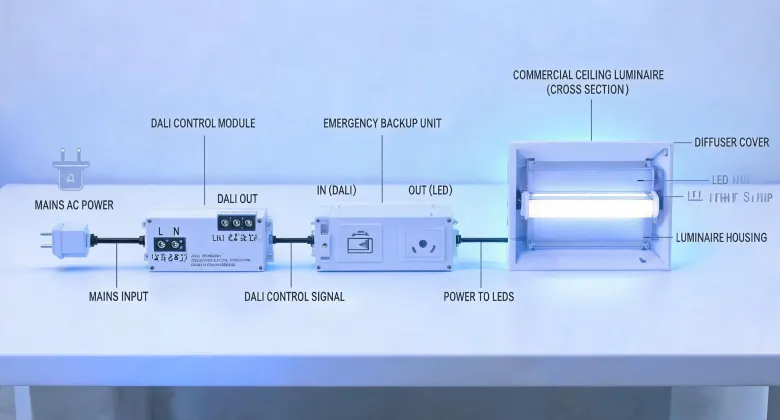
Samsung LED lights integrate with Zigbee-based lighting controls—occupancy sensing, daylight harvesting, scene scheduling. One hotel client cut corridor energy use by 27% after switching from static downlights to controllable Samsung LED fixtures. I saw the numbers from their energy audit; the savings were real.
Budget fixtures? They have an on/off switch. If you're lucky, a dimmable driver. But try integrating a no-name downlight with a building management system and you'll spend hours fighting incompatible drivers and undocumented protocols. People assume smart controls are a futuristic extra. The reality is they're increasingly a baseline expectation in offices and hospitality—tenants ask for them, building managers want them, and energy codes are starting to require them.
If you're in a hurry, here's the short version: the lights that are more reliable and faster to replace are also the ones that support smart controls. The advantages stack, not compete.
The Plot Twist: When Budget Fixtures Are the Right Call
After all that, here's the counterintuitive finding: I still buy budget downlights sometimes.
For temporary construction lighting, a renovation site where the fixtures get ripped out in six months, or an area where color consistency doesn't matter, why pay a premium? Budget lights produce light. That's their job, and they do it acceptably for the first year or two. Paying $30 for a fixture that only needs to work for six months is genuine waste.
So this is not a "Samsung is always the answer" article. It's a "know what you're paying for" article. The premium on Samsung LED lights is buying certainty—certainty of lifespan, certainty of color consistency, certainty of replacement availability, certainty of controls compatibility. If you don't need those things, don't pay for them.
So Which Should You Choose?
Here's my practical rule of thumb, based on years of emergency callouts:
Choose Samsung LED ceiling lights when:
- The space is client-facing: lobbies, conference rooms, retail floors, guest rooms
- You need consistent color across a large downlight ceiling installation
- You want smart lighting controls now or in the next few years
- Fast replacement availability matters when a fixture fails
Choose budget downlights when:
- The space is non-critical: storage, plant rooms, temporary sites
- Your upfront budget genuinely can't absorb the premium
- Someone else owns the building and will deal with maintenance
- You can tolerate shorter lifespan and potential color drift
One more tip from the field: buy a spare. The cheapest emergency repair is the one you never make. Keep one Samsung LED downlight in a storeroom for every twenty you install. The next time a ceiling light dies at 11 PM, you won't be calling strangers—you'll be grabbing a ladder.