You're Probably Asking the Wrong Question
Most people start with price and style. I used to too. In 2023, I approved a pendant that looked like a $900 fixture for $400. Same shape, same finish, same diameter. It had to be the same, right? It wasn't. The driver hummed. The dimmer flickered from 40% down. One canopy arrived cracked. The vendor blamed shipping; the installer charged for a second trip. That 'bargain' ended up costing about $800 more than the original quote.
That's why when someone asks me how to choose a pendant light, I tell them to ignore the photo for a minute and read the spec sheet. I'm a procurement manager at a 20-person hospitality design firm. I've tracked our lighting and AV budget for six years—about $180,000 annually—and documented every order in our cost tracking system. The choices that look cheaper on paper rarely are.
The Spec Sheet Is the Purchase Order
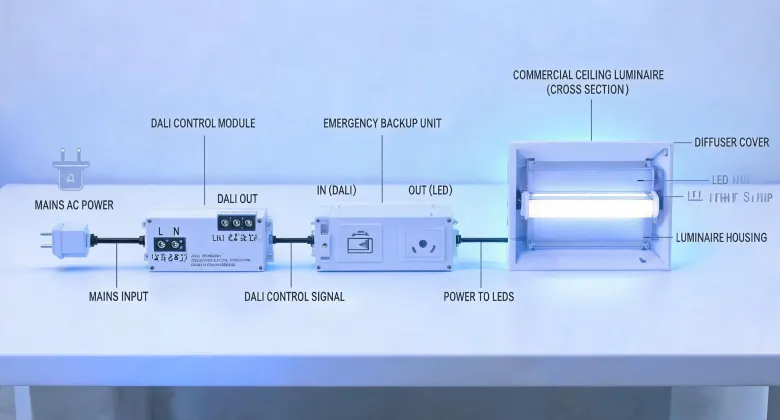
A pendant fixture is not just a light bulb. It's a driver, a heat sink, an optical assembly, a housing, and a connection point for a control system. Each one can add hidden cost.
Driver quality. The driver is the first thing to fail in cheap fixtures. Replacing one usually requires an electrician, and depending on ceiling height, a lift. A $92 driver can cost $150 to $400 to install. I didn't fully understand the value of a named driver until a March 2023 failure took out six lobby pendants and forced us to rent a scissor lift for a part that cost less than the rental. When I compared two similar pendants side by side—one with a named driver and a 5-year warranty, one with no driver brand and a one-year warranty—I understood why 'looks identical' isn't a specification. The expensive one included a spare driver in the box. That spare driver covered most of the price difference.
Color consistency. White LEDs are sorted into bins. Two fixtures from the same manufacturer can ship with noticeably different shades if the vendor doesn't specify a bin. In print, color tolerance matters (Pantone's Delta E < 2 is the brand-critical benchmark). LED fixtures use MacAdam steps instead; if the vendor can't tell you a 3-step MacAdam ellipse, you're buying a lottery ticket.
Controls and certifications. Here's where I've learned to be skeptical. A fixture that says 'Zigbee compatible' is different from one that is Zigbee certified. I follow Zigbee news more than most procurement people, because the standard keeps evolving. Certified devices from the Connectivity Standards Alliance are more likely to work with your existing hub. 'Compatible' just means someone tested it once in a lab. Maybe. (Mental note: never assume 'compatible' means certified.)
The Lobby TV Lesson
I keep learning the same lesson on the display side of my budget. When our lobby needed a TV, I started with a Samsung 32 inch TV LED price because it looked like the obvious low-cost option. The Samsung UN32M4500 HD Smart LED TV is a fine consumer television. But our lobby needed commercial mounting holes, an RS-232 port, and a panel that could run 16 hours a day. The cheaper model wasn't wrong—it was specified for a different job.
Pendant lights work the same way. A residential fixture may use LEDs rated for 3 hours a night. A commercial lobby needs 12 hours. The housing may not have the insulation class your building inspector expects. Samsung LED chips in a fixture give me a useful baseline, but only if the rest of the specification is honest.
This isn't an argument for always buying commercial-grade. It's an argument for matching the product to the duty cycle. If your pendant is for a home dining room, a simple residential fixture may be perfect. If it's for a hotel lobby, the duty cycle changes the equation.
The Access Problem Everyone Forgets
A pendant over a high ceiling looks elegant until a lamp needs changing.
If the fixture hangs over a lobby or a conference table, you need a maintenance plan. A chandelier motor—yes, a motorized lift for large pendants and chandeliers—can solve access, but it adds $1,200 to $2,500 to the installed price. If you skip it, you'll pay for a lift rental every time. We've done both. After three years, the rentals cost more than the motor. So glad I insisted on the chandelier motor for the new lobby. I was one signature away from cutting it to save $1,800.
I still kick myself for not ordering spare drivers with our first batch of pendants. If I had, we would have avoided expedited shipping and a second service call. I now add replacement parts to the initial purchase order, not to the emergency budget.
What Ignoring These Costs Actually Does
When I audited our 2023 spending, I found that 28% of our lighting budget overruns came from installation, rework, and emergency access—not from the initial fixture price. Not from the fixture at all.
The cost of a poorly chosen pendant light is the wrong color temperature in a dining room. The faint hum in a meeting room. The Zigbee light that drops off the network after a firmware update. The 'free setup' that wasn't. In one order, that free setup added $450 in hidden fees after we had to pay for an extra site visit.
If the vendor can't tell you the driver brand, the LED bin, and the certification level, you're not buying a light. You're buying a promise.
Sure, a $400 fixture can be fine in a low-ceiling lounge with easy access and a simple dimmer. But 'fine' isn't a specification. The same fixture in a double-height lobby, with a Zigbee controller, on a 10-hour schedule, is a completely different product. Unless you define the conditions first, 'choose a pendant light' is a question with an infinite number of answers.
A Better Way to Choose a Pendant Light
I do not mean you need the most expensive fixture. I mean you need the complete one.
- Ask for the driver brand and LED bin. If they're not listed, that's a red flag.
- Compare total installed cost: fixture, driver, installation, controls, lift access, and spare parts.
- Check the Zigbee certification, not the product page.
- For high ceilings, include a chandelier motor or a service contract in the original bid.
- Get the warranty and after-sales support in writing.
That's how to choose a pendant light without turning a one-time purchase into an annual subscription of regret. The right fixture isn't the one that looks closest on a screen. It's the one whose spec sheet, controls, and service plan survive contact with your building.