Here’s the short version: In five years of purchasing for a 180-person company, I’ve placed more than 500 orders, from paper clips to a 100-inch Samsung TV. The most important rule I’ve learned: specifications always beat marketing claims. Whether you’re buying a $45 downlight kit or a premium smart display, the product that works is the one whose specs match your actual conditions. And if you’re a small buyer, know this: good vendors—like Samsung LED—will take your order seriously. I’ve been the $200 client, and I’ve been the $20,000 client. The difference wasn’t how much I spent; it was how specific I had to be.
My official title is office administrator, but I handle facilities and technology purchasing for three locations. That means managing around 8 vendors and roughly $70,000 a year in orders—mostly LED lighting, displays, and AV accessories. In other words, I’m not a professional lighting designer. I’m the person who has to live with the results. One failed order can cost me a week of complaints and a chunk of the annual budget.
Five years ago, I trusted a product title that said “Dimmable LED downlight kit” and skipped the spec sheet. The lights worked fine on standard switches—until they were connected to the existing dimmers in the break room. They flickered like a bad fluorescent tube. Replacing them cost $640 and two colleague grumbles per day for a month. That’s when I learned to verify driver compatibility before ordering. Someone told me once to check the specs. I ignored it. I paid the price. Now I check everything—once on the product page and once on the manufacturer’s PDF.
The most frustrating part of buying commercial LED lighting: the same spec words mean different things in different product families. You’d think “LED” and “dimmable” are globally consistent. They’re not. That’s why I now write to the vendor before placing any order with a dimming requirement. It saves hours and reorder costs.
What Actually Matters in LED Light Fixtures
According to the U.S. Department of Energy (energy.gov), LED lighting uses at least 75% less energy than incandescent lighting. That’s a solid reason to switch, but it’s not the main challenge. The challenge is matching the fixture to the room. Here are the three specs I check on every downlight kit and light wall order:
- Color temperature. 3000K for lounge and reception, 4000K for work areas. Mixing the two in one open plan looks sloppy.
- CRI. Anything below 80 looks washed-out. For showrooms or receptions, CRI 90+ makes the space feel less institutional.
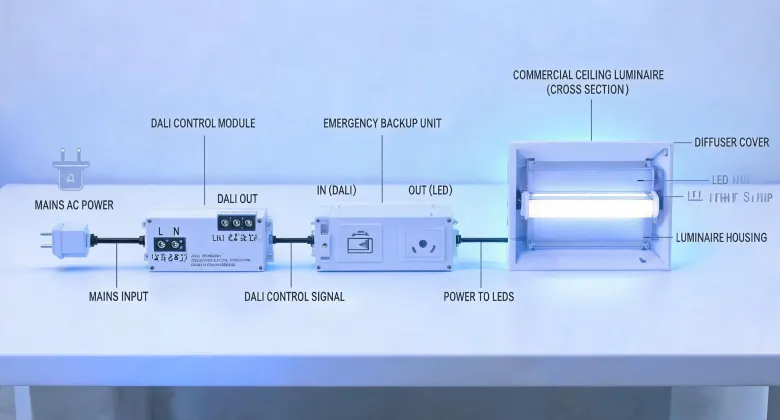
- Driver compatibility. For dimmable kits, the driver needs to match your switch type, or you get flicker. This is the gotcha that tripped me up.
When you search “light wall,” you get everything from accent wall panels to linear LED wall washers. In an office, we use the washer style for light walls in corridors and the downlight kit for general ceiling fixtures. The wall washers we chose are 4000K because they’re near work areas; the downlights in the lobby are 3000K. It sounds like a minor detail, but it shapes how people describe the building: “warm” vs. “clinical.”
One more thing: calculate total cost of ownership. A downlight kit may be $35, but if it needs a special dimmer, an isolated mounting frame, or a driver that isn't included, the real cost is $60. The “cheap” kit that failed us ended up costing $200 by the time we paid an electrician to swap the drivers. The “expensive” kit that worked out of the box would have been cheaper.
Motion sensor light switches
You probably don’t think about “how do motion sensor light switches work” until one of them stops working. The short answer: they detect occupancy either by passive infrared (PIR—your body heat) or ultrasonic (micro movement). PIR is cheaper and less sensitive; ultrasonic covers a wider area, but can falsely trigger from HVAC airflow. The office lesson is to pick a switch rated for LED loads. Some older switches were designed for halogens and resist the low wattage of LEDs, leaving lights stuck on or randomly off. Also, ultrasonic sensors in rooms with ceiling fans or blowing vents can cause phantom activations. So, if someone asks me which sensing technology to choose, I say: PIR for private offices, dual-technology for conference rooms.
My Experience with Samsung LED TVs in the Office
Displays are a different game. For small huddle rooms, a tv led samsung 40 inch does the job nicely. It fits on a standard 400x400 VESA mount, doesn’t dominate the room, and the price lets us budget for a better soundbar. The biggest surprise: our 40-inch TV’s brightness beats a lot of cheaper 55-inch models in daylight conditions. In a conference room with floor-to-ceiling windows, brightness matters more than diagonal size.
For the big boardroom, we went with the Samsung QN100QN80FF 100″ Smart LED-LCD 4K UHD TV. I’ll be honest: it’s a statement piece. But it’s also practical. When you’re presenting financial models or 4K mockups, seeing the whole sheet without squinting is worth the price. Just make sure the wall is reinforced. The install alone took a team of three with a specialized mount.
A counterintuitive note: for the large TV, I considered a higher-end model with fancy features, but the QN100QN80FF’s listed specs—4K, 100-inch panel, LED-LCD backlight—were sufficient. In a commercial setting, the operating system matters less than the input ports and brightness. “Smart” features are nice; HDMI ports are essential. We connected a wireless presentation system and a conference camera, both on different inputs. If the TV doesn't have enough ports, you end up with a relay switch and another point of failure.
What’s the one spec I check on every office TV? Brightness, measured in nits. If a display can’t fight daylight, no amount of resolution helps. That’s the main reason a modest 40-inch TV succeeded in our bright rooms where a cheaper 55-inch model failed.
One thing I keep telling colleagues who are intimidated by buying from a global tech brand: Samsung LED treated our small orders seriously. When I started, I was ordering maybe $250 worth of downlight kits. The response time and datasheets were the same as when we later ordered the TV. A sales rep walked me through the sensor switch compatibility question without pushing me to upgrade everything. That’s rare. I’ve had vendors who made me feel like a nuisance for placing small trial orders. Samsung didn't.
When This Advice Doesn’t Apply
Here’s the honest part. My experience is from an office environment in an existing building, not from new construction or a luxury hospitality project. If you’re renovating a hotel lobby, you need a lighting designer who will do photometric calculations. And if you are a homeowner, smart-home protocol compatibility (Zigbee, for example) will influence your choices more than it does for me. We do consider Zigbee for future office automation, but it’s a “nice to have,” not a daily need.
Also, prices are dynamic. The figures I mention are from our 2025 purchase orders; verify current specs and prices on Samsung’s official pages before committing. And remember to include installation, compatible controls, and future replacements in your budget. The cheapest fixture with an incompatible driver is more expensive than the reliable one that just works.
So whether you’re replacing a single downlight or furnishing an entire conference room, start with the spec sheet—not the fixture photo. For LED lighting and displays, let the environment determine the spec, and once it does, choose a brand you can hold to the datasheets. Samsung LED has, so far, kept their promises to us. And if you're working with a small budget or a small order, don't accept low service. A vendor that values a $200 order demonstrates the process discipline you'll need when the order becomes $20,000.