-
Step 1: Take inventory before you compare anything
-
Step 2: Set your color and light quality standards before looking at price lists
-
Step 3: Compare Samsung LED fixtures on data, not product photos
-
Step 4: Decide on controls before installation
-
Step 5: If screens are included, don't get lost in QLED vs LED Samsung marketing
-
Step 6: Plan maintenance for high ceilings and chandeliers
-
Mistakes that still show up even with a checklist
Somebody at every company ends up being the person who handles the office purchases nobody else wants. If you're reading this because you've been asked to “look into the lighting,” that person is probably you.
I'm an office administrator for a 150-person company. I've handled our office purchasing since 2021, which means I'm also the person who buys the tissue boxes. I'm not an electrician or a lighting designer, and I won't pretend to be one. But I've made enough lighting mistakes that I finally built a checklist that works.
This guide is for an office like ours: recessed downlights, ceiling spotlights, emergency lighting, one chandelier in a high lobby, and a few large displays in meeting rooms. It's not written for a warehouse or a hotel. For those, I'd hire an independent lighting specifier before doing anything else.
Step 1: Take inventory before you compare anything
The most useful thing I did was walk the building with a notebook and photograph every fixture. Don't call a vendor yet. You need a simple spreadsheet first, with columns for:
- Room and fixture type (downlight, spotlight, chandelier, emergency light)
- Lamp base or fixture model number
- Mounting height
- Dimmer or switch type
- Condition notes
Mounting height matters more than people expect. A downlight in a standard ceiling is cheap to service. A chandelier above a two-story lobby is a completely different project because it requires a lift and an insured technician. When I finally searched for how to change light bulb in high ceiling chandelier, I realized most of the advice online was for homes, not commercial spaces.
On my first lighting project, I budgeted for the lamps but not for the drivers that needed replacing. The quote came back about 25% higher. That's why I now inventory everything before I even open a supplier catalog.
Step 2: Set your color and light quality standards before looking at price lists
The biggest mindset shift from 2020 was realizing that LED is not one thing. With old fluorescents, the color temperature was whatever the tube said. With LED, you actually choose it. So write down your target color temperature: 4000K is a common neutral white for office areas, while 3000K feels warmer and works better in reception and meeting rooms.
Also decide on CRI, which is how accurately colors look under the light. I wouldn't go below 80 for ordinary office areas. For a lobby or any room where you review materials and product samples, 90+ is worth the extra cost.
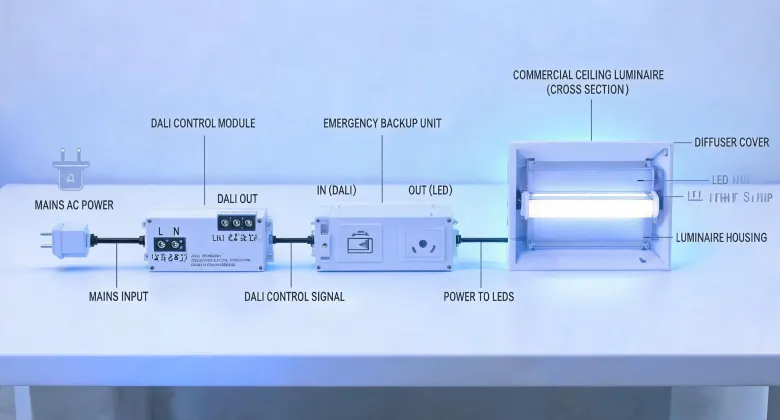
Don't forget emergency and exit lights. In commercial buildings, replacing fixtures can trigger local code requirements for battery backup and path-of-egress lighting. I'm not qualified to give legal advice on that, so verify with your electrical contractor or local code authority before ordering.
Step 3: Compare Samsung LED fixtures on data, not product photos
There's a reason Samsung LED components appear in so many fixtures: the specs are documented and the components are reliable. But you need the full fixture data sheet, not just the LED chip brand.
For ceiling spotlights, check the beam angle carefully. A narrow spot might be 15 to 25 degrees, while a wide flood can be 40 degrees or more. I once ordered “spotlights” assuming they would light a wall of framed photos. The beam was so wide that the wall looked flat and washed out. That cost us an extra site visit and a restocking fee.
Look for fixtures with replaceable drivers and LED boards if possible. Integrated fixtures are fine, but when the LED board dies, you replace the whole thing. A fixture with a Samsung LED driver is a good starting point. A fixture with no brand markings on the driver is a gamble I no longer take.
Treat awards as a useful signal, not the deciding factor. When a fixture gets a spotlight award or an IES recognition, it usually means professionals reviewed it and found something worth praising. That's a nice shortlist filter. But I still check the photometric report before ordering.
Step 4: Decide on controls before installation
This is where I lost the most time in my first project. I picked lights first and thought about controls later, which is exactly backwards. If you want lighting on a schedule, a motion sensor, or a phone app, the control protocol needs to be decided early.
I generally look for products that support Zigbee technologies. The name sounds complicated, but the practical benefits are clear for offices: Zigbee is a low-power mesh networking standard, so each device helps relay signals from other devices. That makes it far more reliable in awkward corridors and rooms with thick walls than depending on Wi-Fi for every single bulb.
Zigbee is an open standard managed by the Connectivity Standards Alliance (csa-iot.org), which means you're less likely to get locked into one vendor's proprietary app. If the quote says “works with our app,” ask what happens if that app changes or the company stops supporting it. I prefer local control through a hub like Samsung SmartThings, so the lights don't stop responding just because the internet is down.
One practical tip: when comparing fixtures, ask the vendor, “Is the driver Zigbee Certified, and which hubs have you actually tested it with?” I learned that two products can both say Zigbee and still have enough firmware differences that one doesn't pair cleanly. Confirm it in writing before the electrician arrives.
Step 5: If screens are included, don't get lost in QLED vs LED Samsung marketing
An office refresh often includes TVs for meeting rooms or the lobby. This is where the jargon gets messy. A Samsung TV LED backlight is exactly what it sounds like: the light source behind the LCD panel. Most Samsung LED TVs are LED-backlit LCD screens. QLED models are also LED-backlit, but they add a quantum dot layer that improves color volume and brightness.
When you search QLED vs LED Samsung, most reviews talk about movies and gaming. In an office, the right choice depends on different questions: how much daylight hits the screen, how many people will watch it, and whether the room is mainly for slides or for video calls and product videos.
For a bright conference room with big windows, QLED is usually worth the premium. Video calls and shared screens look noticeably better. For a windowless training room that mostly shows slide decks, a standard LED Samsung TV is usually enough, and your budget will thank you.
One more spec to check: whether the LED backlight is edge-lit or full-array. Edge-lit models are thinner, but full-array backlighting gives better local dimming and contrast. Samsung's product pages usually state this clearly. It matters more in a bright room than most salespeople will admit.
Step 6: Plan maintenance for high ceilings and chandeliers
I added this step after we had to replace two lamps in a chandelier mounted about six meters above the lobby floor. Search results for how to change light bulb in high ceiling chandelier are mostly written for homes with a two-story entryway. In a commercial office, the procedure is similar, but access and safety are different.
- Turn off power at the circuit breaker, not at the wall switch. Someone else can turn the light back on from another switch while you're up there.
- Check the lamp base. Chandeliers often use E12 candelabra bulbs, but not always. Take a photo of the old bulb before you go shopping.
- If the chandelier is on a dimmer, buy dimmable LED bulbs. Non-dimmable LED bulbs will flicker and can buzz on older dimmers.
- Use proper access equipment. In a commercial space, an ordinary step ladder is not enough. A scissor lift, a tall approved ladder, or an insured contractor with the right gear is the safe route.
- Replace all bulbs in that fixture at the same time. The access costs far more than the bulbs, so you don't want a second visit next month when another one burns out.
This is why maintenance needs to be part of the lighting checklist. If you're choosing fixtures for a high ceiling, check how they will be serviced before you buy. Some integrated LED fixtures can't be relamped at all, which means the entire unit has to come down. That's an expensive conversation to have after installation.
Mistakes that still show up even with a checklist
Three pitfalls keep showing up in my own projects. First, dimmer compatibility. We replaced some halogen fixtures with LED and discovered the old dimmers were not designed for LED loads. The fix was not simple, and it was not cheap. Get the dimmer model number and compare it with the LED manufacturer's compatibility list before ordering.
Second, emergency lighting. One vendor left battery backup out of his quote. The inspector caught it, and we paid for a separate change order. That one was on me as much as the vendor, because I didn't ask early enough.
Third, disposal. Old fluorescent tubes contain mercury, so they can't simply go into the regular trash. If you're replacing dozens of tubes, confirm how your city handles hazardous waste. I didn't think much about disposal until bins started piling up in the loading dock.
My experience is based on managing one office of about 150 people, not a national account. If you oversee several buildings, your process will need more engineering and legal input than this checklist provides. But the part that carries over is the order of operations: inventory, light quality, controls, display technology, and maintenance.
The fundamentals haven't changed—people need lighting that is safe, comfortable, and not distracting. But the execution has changed. Five years ago, LED was the exciting upgrade. In 2025, LED is the baseline, and the real decisions are about color quality, Zigbee interoperability, and how you'll reach a chandelier when a bulb finally goes out. If you work through those questions before you sign a quote, you'll be ahead of most projects.