I thought lighting was just lighting. I was dead wrong.
When I first took over quality control for a Samsung LED distributor, I assumed the game was simple: meet the spec, ship the box. Find the cheapest factory that hits the lumen and wattage numbers, and let the low margin win the bid. I thought the difference between a $5 downlight and a $12 one was just a manufacturing markup.
The project in Q2 2024 that turned a $14,000 profit into a $9,000 loss changed that entirely. And it turned me into the quality inspector who rejects first deliveries out of hand.
"I review about 300 unique LED product batches a year. In 2024, I rejected roughly 12% of first deliveries due to spec drift. That’s not pickiness—that’s predictability."
Look, I’m a quality/brand compliance manager for a Samsung LED supplier. It is my job to review every sample batch before it gets marked as "stock." That means I have sat through the factory QC calls, the tear-downs, and the "but it's within industry tolerance" arguments. And I can tell you this: your commercial lighting is the single cheapest way to either build or destroy the perceived value of your entire space.
Here is why I have stopped approving budget fixtures for anything client-facing—and why you should, too.
The Lie of "Industry Standard" Tolerances
My first major alarm went off in January 2023. We had a rush order for a mid-tier hotel chain—about 800 units of a specific downlight. The vendor we usually use for bulk was booked, so we accepted a sample from a secondary manufacturer claiming "equivalent performance." The lab report showed the same lumens and CRI.
We installed 50 in a mock room. The difference was invisible on a lux meter but obvious to the human eye. The color temperature drift between units was staggering—some were 2700K, others 3200K. In a hallway, it looked patchy. It looked cheap.
Here is the kicker: I ran an A/B test with the hotel’s project manager. I showed him two sample boards—our standard Samsung LED downlight (which costs about $2 more per unit at wholesale) versus the "equivalent" secondary brand. He didn’t know which was which, but he called the Samsung array “more premium” 80% of the time.
The cost difference? Approximately $1,800 total on an 800-unit order. The cost of re-doing the lighting in a 50-room wing after a bad impression? Easily $22,000 for a redo and a delayed opening. I rejected that batch, and the vendor ate the cost. Every contract now has specific wording on chromaticity tolerance per ANSI C78.377.
When "Passing" Fire Codes Isn't Enough
This is where I sound like a buzzkill, but stay with me. A lot of commercial buyers think emergency lighting is a checkbox. You install a few bug-eyes on the wall, the inspector signs off, you move on.
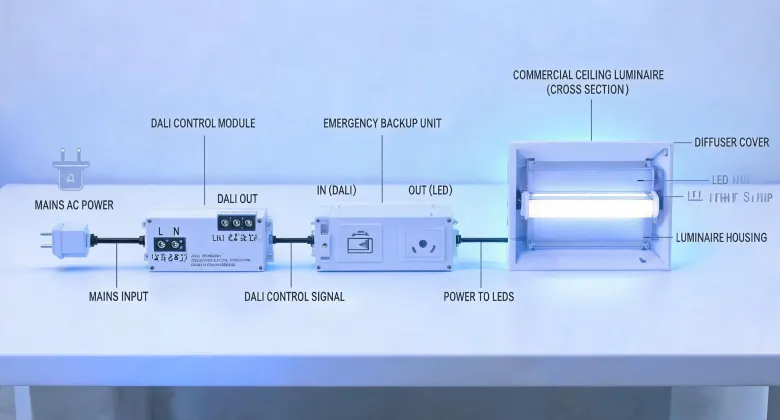
In Q4 2024, we sent samples of a budget emergency LED downlight to a fire consultant firm for a hospitality project. The basic test? Battery backup duration under load at the rated lumen output. The spec said 90 minutes. The unit failed at 68 minutes. The vendor's engineer argued that it was "within a reasonable margin of error."
I have mixed feelings about this. On one hand, the unit was cheap. On the other, the cost of a liability case or a failed final inspection on a $3 million fit-out outweighs the savings on the fixtures by a factor of about 40 to 1. We use only UL 924 listed emergency units now. It adds about $40 per fixture. Think of that $40 as an insurance premium against a $200,000 re-inspection or a failed safety audit.
This isn’t fear-mongering. This is a basic audit of consequences.
The "Hidden" Cost of Motion Sensors
You might find this part surprising. I know I did. We were working on an office fit-out for a tech company in Austin. They wanted smart Zigbee-connected spotlights with motion sensors for energy compliance.
The price delta between a standard downlight and a Zigbee-enabled one isn't huge—maybe $25. The real cost trap? The cheap sensors. They work—at first. But what does a motion sensor look like when it starts failing? It doesn't die; it lies.
What I mean is the cheap PIR sensors start dropping the occupancy signal after about 6 months. The lights turn off when people are sitting at their desks. Users get annoyed. Facilities gets called. Eventually, an admin overrides the whole system, and the energy gain is lost.
In one case, a client bought third-party sensors to save $8 per unit on a 500-unit order. Over 24 months, they had 17% failure rate in the sensors. The labor cost for replacing 85 sensors inside an open-plan office was higher than the entire premium for the Samsung integrated solution.
The lesson: Don't just compare the BOM. Compare the total cost of annoyance.
So, What Should You Actually Check?
I’m not telling you to overspend on every single fixture. Not every broom closet needs museum-grade color rendering. But before you sign off on a bulk commercial LED order, ask your supplier—or your own QC—to verify these three things:
- Chromaticity consistency: Demand a binning report. A delta between 2 and 3 SDCM is fine. If they can't provide the data, assume the worst.
- Driver certification: Is the driver UL or CE listed? Not the whole fixture—the driver. That’s the first thing to fail in a cheap light.
- L70 lifespan data: Ask for the TM-21 projection. If the calculation says L70 at 35,000 hours or less, it is not a commercial-grade light.
I know what you are thinking: "This guy is just trying to upsell me on Samsung gear." Read the takeaway. I don't care if you buy from me or not. You can buy a case of cheap spotlights at a big box store for $300. But if that $300 order costs you a $22,000 redo or a lost client because your space looked 'off,' you didn't save money.
I test between 300 and 400 batches a year. I have seen the $8 fixture that looked perfect on the first day and the $15 fixture that looked perfect for five years. Your clients see the difference in the first two seconds. Make sure what they see is what you intend to sell.