-
My unpopular opinion: the cross reference guide is more valuable than the price sheet
-
The mistake I made with a Sylvania LED H13 order
-
What I changed, and why every order now gets a five-minute pre-check
-
The smart lighting half of this problem is worse, not better
-
Does smart lighting actually save energy? Yes, but the number depends on the room
-
"But speed matters more than checking" — does it?
-
The takeaway I keep putting in front of people
My unpopular opinion: the cross reference guide is more valuable than the price sheet
I took over purchasing coordination for our company in 2020. Before that, I was the person who approved facility invoices, which means I got to see every order that went sideways. And I'll be honest: I didn't start out as a person who checks SKU compatibility twice. I became one.
Here's the short version of my position: in lighting procurement, the cheapest decision is almost never the cost on the invoice. It's whether the part actually fits. A $400 order of the wrong Sylvania lamp costs you $400, plus the labor to return it, plus the re-ship, plus the downtime in whatever room or vehicle was waiting on it. A 10-minute cross reference check before you click "buy" costs you 10 minutes.
I know that sounds obvious. It didn't feel obvious to me in 2020.
The mistake I made with a Sylvania LED H13 order
Our company runs a small fleet — around 14 vehicles, mostly service trucks and two shuttle vans. When drivers report a headlight out, my job is to order replacements and get them to the shop. Not glamorous, but it lands on my desk.
In early 2022, we had three trucks with bad headlights in the same week. The shop foreman texted me: "Need Sylvania H13, LED if you can." I'd ordered Sylvania H13 bulbs before — or at least I thought I had. I pulled up the old invoice, copied the part number, and placed the order without checking whether the part number actually matched the year and trim of those trucks.
It didn't.
Here's what I'd missed, and what the Sylvania lamp cross reference guide would've told me in about 90 seconds: an H13 bulb (also sold as 9008) is a dual-filament bulb — it handles both low and high beam in a single housing. But not every vehicle that "takes an H13" is happy with every LED H13 retrofit. Some LED H13 replacements run hotter than the OEM halogens or draw differently, and the housing can throw a flicker or a CAN-bus error. Two of the three trucks had aftermarket housings installed by the previous fleet manager. Those were the ones that flickered.
The third truck was fine. But by the time we figured out which was which, we'd paid a restocking fee on two returns and eaten a week of the shop manager telling anyone who would listen that "the office ordered the wrong bulbs."
Small money in the grand scheme — a couple hundred in fees plus shipping. The reputational cost at the shop was worse.
I knew I should've pulled the cross reference before ordering. I told myself "we've done this before, what are the odds?" The odds were 2 in 3, apparently.
What I changed, and why every order now gets a five-minute pre-check
After that week I built what I now call the ten-point bulb and fixture check. It's not fancy. It's a half-sheet of paper taped inside my ordering notebook. But I run it on every lighting order that's not a straight replenishment of a part we've bought in the last 90 days.
- Base type and wattage (match the socket, not just the "looks similar" shape)
- Voltage — commercial buildings run 120V or 277V; mix these up and the ballast or driver doesn't survive
- Color temperature consistency across the same space (2700K vs 3000K vs 4000K is a real headache when someone orders "warm white" and gets 4000K)
- Dimmability — is the new lamp compatible with the existing dimmer, or is the dimmer doing the cheap flicker thing at 20%?
- For automotive: vehicle year, trim, and housing type (OEM vs aftermarket)
- For automotive: does the vehicle have a CAN-bus or bulb-out warning system?
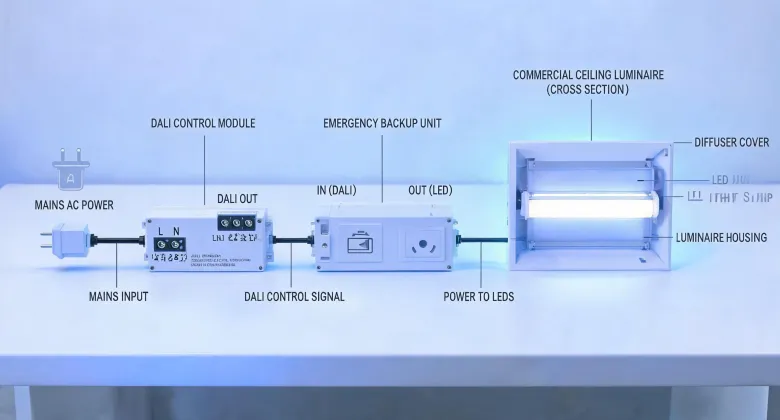
- For smart products: which Zigbee hub or gateway is actually compatible?
- For motion sensors: coverage angle and range vs the room dimensions
- Fixture housing restrictions (enclosed vs open, damp/wet location rating)
- Return policy and restocking fee on the specific SKU
Five of those ten are the reason I've stopped "just reordering the old part number." The old part number is only right if the room, the fixture, or the vehicle hasn't changed. And in a company that's swapped conference rooms around twice in two years and replaced a fleet of trucks, things change.
The smart lighting half of this problem is worse, not better
Everything I just said about bulbs applies doubly to smart lighting. And this is where the Zigbee question bites.
We had a tenant improvement project in late 2023 — a small break area and two conference rooms. The electrician spec'd Sylvania smart fixtures with Zigbee control and motion sensors. My job was to buy the pieces. Easy, right?
Nope. The Zigbee "website" answer — I mean the official connectivity page from the manufacturer — makes it clear that Zigbee is a protocol, not a plug-and-play standard. Some Zigbee hubs only pair with their own brand's devices. Some gateways support third-party sensors; some don't. And the sensor that ships with a fixture doesn't always speak to the gateway you already have installed in the closet.
We got lucky. Our existing building system happened to be a Zigbee-compatible hub that accepted the new devices. But I didn't know that when I placed the order — I assumed it. If I'd been wrong, we'd have been looking at a $2,400+ mistake: sensors that turn on lights for nobody, and a contractor asking why the "smart" room needs its light switches walked over and flipped manually.
So now — and this is the rule that has leaked into every other area of my job — I confirm the controller before I confirm the price.
Does smart lighting actually save energy? Yes, but the number depends on the room
I get asked this a lot by people in operations who are hearing the pitch. The honest answer is: the savings are real, but not uniform. The U.S. Department of Energy's guidance on lighting controls has consistently found that occupancy sensors alone typically cut lighting energy use by around 20% to 60% in spaces like restrooms, storage rooms, and intermittently used corridors — but the same sensors do very little in a break room where people are already flipping switches on habit.
Our break-area sensor earned its keep. The two conference rooms are basically a wash, because they're occupied 70% of the working day anyway. If I'd bought sensors for every room on the floor based on a vendor's brochure ("saves up to 60%!"), I'd have overbought by about 40%.
The energy savings from LED retrofits are more predictable. But again, the number moves depending on what you're replacing. An LED tube replacing a 32W T8 fluorescent is a different calculation than an LED H13 replacing a halogen headlamp, because the latter isn't really about energy at all — it's about brightness, lifespan, and whether the driver electronics play nice with the vehicle.
"But speed matters more than checking" — does it?
I hear this from operations and from the shop. I need the part tomorrow, not after you do your little spreadsheet thing.
Fair. Speed matters. But I'd push back on the premise, because the two aren't actually in opposition. My ten-point check takes about five minutes in a spreadsheet I built once and reuse. That's roughly the length of one coffee refill. If the check fails, I save myself a week of returns and an uncomfortable conversation. If it passes, I've lost five minutes and gained confidence that the thing I just bought will actually work.
The one argument I'll accept is that checking isn't always worth it. If I'm reordering the exact same SKU we bought three months ago, from the exact same supplier, for the exact same room — I don't run the ten-point. I look at the last invoice and reorder. That's not laziness; it's knowing which orders carry risk and which don't. The check is insurance. Insurance on a $40 restock is not worth the premium.
But the Sylvania cross reference guide? That's on the check every time an order is for a new part, a new vehicle, or a new room. Because that's where the surprises live. That's where the drivers with aftermarket housings hide, and the Zigbee gateway in the closet that doesn't want to talk to the sensor you just bought.
The takeaway I keep putting in front of people
Lighting procurement is a small corner of my job. Most people in my role don't spend real time on it — they reorder the old part number and hope. I get that, because I did that too, until the week of the two flickering H13s.
The 10-point pre-check costs me maybe an hour a month. In 2024 alone it caught: a 277V fixture that was about to go into a 120V space (would have fried a driver), a Zigbee sensor paired to the wrong gateway (saved ~$600), and a batch of LED tubes that weren't dimmable with our existing wall dimmers (saved the electrician a return trip and us the labor).
That's roughly $8,000 in potential rework avoided over the year — and more importantly, zero conversations with a shop foreman about the "office ordering the wrong bulbs." That conversation is worth more than the eight grand.
Five minutes of verification beats five days of correction. Not always, but consistently enough that I built a system around it.
If you're the person who orders lighting for a small fleet, a few offices, or a building with tenants, do yourself one favor this week: open up the Sylvania cross reference guide for the last part number you reordered and see if it actually matches the vehicle or fixture it went into. If it does, great — you're already ahead. If it doesn't, you just saved yourself a bad quarter.