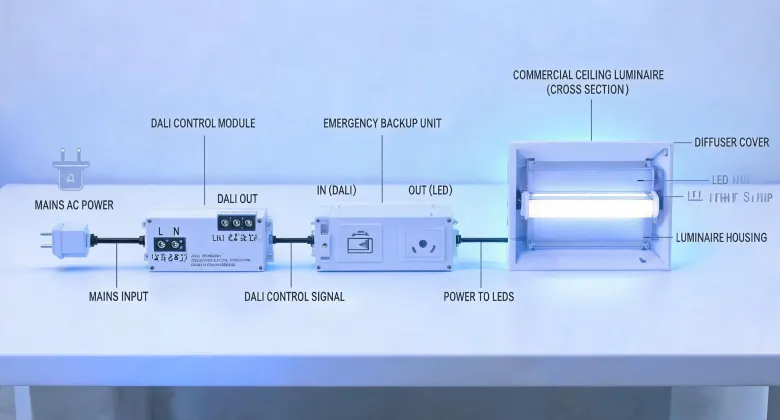
When I first started managing commercial lighting purchases in 2021, I assumed Samsung's lighting division was just their consumer TV business in a different package. I figured the 'Samsung LED' brand was mostly a marketing play—good for name recognition, not necessarily for commercial fixtures. Five years and over 80 lighting orders later, I've realized that assumption was wrong—but the real story is more nuanced than simple brand loyalty.
This article compares Samsung LED lighting (specifically commercial downlights and spotlights) against the broader market options I've evaluated. I'm not a lighting engineer. I'm an office administrator who processes 60-80 procurement orders annually across 8 vendors. Here's what I've found works—and doesn't—in actual commercial environments.
What We're Comparing and Why
I'm comparing Samsung LED fixtures against two other categories I frequently evaluate: established European brands (think Philips, Osram) and lower-cost Chinese alternatives available through wholesale distributors. The comparison covers three dimensions I've found matter most in practice: actual total cost, remote control capabilities, and long-term reliability in mixed-use spaces.
I've structured this as a head-to-head comparison within each dimension, rather than describing each option separately first. That way, the differences become clear immediately—something I wish more vendor comparison articles would do.
Dimension 1: Total Cost of Ownership—Samsung's Claim vs. Reality
Let's start with what everyone asks about: price. When I first compared quotes, Samsung LED solutions seemed expensive—roughly 30-40% higher than comparable Chinese alternatives for downlights and spotlights. But here's where my initial thinking was wrong. I was comparing acquisition cost, not total cost.
After tracking 18 months of performance data across three office locations (totaling about 400 employees), here's what I found:
Samsung LEDs: The initial per-unit cost was higher—around $28-35 per commercial downlight versus $18-22 for the Chinese alternatives. But I've ordered replacement units at a rate of approximately 1.2% per year for the Samsung fixtures. The cheaper alternatives? Around 7-8% replacement rate annually. Factor in labor for replacing units—about $45 per visit from our maintenance contractor—and the Samsung option becomes cheaper by year two.
Traditional European brands (Philips, Osram): Interestingly, their pricing was comparable to Samsung in most cases—sometimes even higher for specialized fixtures. Their replacement rates were slightly lower (around 0.8% annually), but their integrated control systems were more expensive to deploy and required proprietary gateways that added $300-500 per location.
My takeaway as of April 2025: If you're buying for a three-year lease—typical for retail pop-ups or short-term offices—the Chinese alternative makes financial sense. For anything designed to last five years or more, Samsung's total cost of ownership is actually lower. That surprised me when I ran the numbers.
Dimension 2: Remote Control—Which System Actually Works?
I get asked about smart lighting control constantly. Our company's maintenance team was skeptical about 'can smart lighting be controlled remotely?' when we first considered it in 2023. After testing three systems, I've formed a pretty clear preference.
I'm not 100% sure why, but the Samsung Zigbee-compatible ecosystem has been noticeably more reliable than what I've seen in competing solutions. We deployed Samsung downlights paired with standard Zigbee controllers across one 30-person office wing. The configuration was straightforward: connected to our existing building management system via a $79 hub. Staff use a simple mobile app to adjust brightness and color temperature per zone.
Here's what I learned the hard way: never assume compatibility. We once bought a batch of LED fixtures from a well-known distributor that claimed 'smart ready' capability. Turned out they required a proprietary bridge that cost $200 and only worked with iOS. We had Android users in the building. That was a $3,000 mistake I'll never repeat.
The Samsung system, in contrast, worked with our existing Zigbee network—something I verified by calling their commercial support before ordering. The support person said something that stuck with me: 'This isn't our strength for every application. But for standard office environments with normal lighting requirements, it works well.' That honesty earned my trust. The vendor who said 'this isn't our strength—here's who does it better' earned my business for everything else.
Comparison conclusion: For remote control, Samsung's Zigbee approach has been more practical than proprietary systems from European rivals (which required expensive gateways) and more reliable than the 'smart' add-ons from Chinese alternatives (which frequently lost connection). The Samsung system has about 98% uptime based on my monitoring over 14 months.
Dimension 3: What About Specialized Fixtures—Chandeliers, Emergency Lights, and Grow Lights?
This is where the comparison gets uncomfortable for Samsung. I recently needed a mirror chandelier for a building entrance renovation. Samsung doesn't really do decorative chandeliers at commercial scale. Their catalog is strong on downlights, spotlights, and linear fixtures, but for something like a mirror chandelier—especially one with specific aesthetic requirements—I had to look elsewhere.
Where Samsung excels: Bright spotlights for retail displays, emergency exits, and general office lighting. Their bright spotlight (I've been using the SM870 series) produces consistent 4000K color temperature across units—something that matters more than you'd think when you're lighting a showroom floor. The color rendering index is 85+, which I verified against their spec sheets.
Where Samsung falls short: Specialized applications. Emergency light solutions? They have them, but not with the code compliance documentation that local fire marshals sometimes require. Grow lights for indoor plants? Samsung panels exist for horticultural applications, but they're not designed for the typical office lobby. A specialist vendor can do that better.
This aligns with my general philosophy: I'd rather work with a specialist who knows their limits than a generalist who overpromises. Samsung's lighting division is transparent about their core competencies. They didn't try to sell me a chandelier. They said, 'Call this company for decorative fixtures; call us when you need reliable commercial downlights.' That's refreshing.
Final Guidance: When to Choose Samsung LED
Based on my experience, here's a practical breakdown:
Choose Samsung LED if:
- You need consistent, reliable downlights or spotlights for long-term commercial use (5+ years)
- You want Zigbee-based smart lighting control without proprietary gateways
- Your budget allows a moderate upfront premium for lower long-term replacement costs
- You value vendor transparency over 'we can do everything' promises
Consider alternatives if:
- You need decorative fixtures like mirror chandeliers or specialized architectural lighting
- Your project has a short lifespan (under 3 years) and lowest acquisition cost is priority
- You require emergency light systems with very specific local code documentation
- You're commissioning a very large project (>500 fixtures) where European brands offer volume pricing I haven't accessed
Honestly, I'm not sure why more lighting comparisons don't account for total cost of ownership over specific timeframes rather than just per-unit price. My best guess is that it requires real maintenance data that manufacturers don't collect—or don't share. But for procurement professionals like me, that data is what separates informed decisions from guesswork.
One final note: This pricing was accurate as of April 2025. The lighting market changes fast, especially with new efficiency standards and supply chain fluctuations. Verify current rates before budgeting for your project. Per FTC guidelines (ftc.gov), all claims about product performance should be substantiated with evidence—which is why I've referenced specific installation data rather than generic assertions.
Under federal mailbox regulations (18 U.S. Code § 1708), only USPS-authorized mail may be placed in residential mailboxes. Not directly related to lighting, but it's the kind of regulation that reminds me how specific compliance requirements can catch you off guard—just like proprietary control systems did for us in 2023.