I'm the person who approves or rejects Samsung LED products before they reach customers. Quality compliance manager at a lighting and display company. Over the past four years, I've reviewed 200+ unique items annually. In 2025, I've already rejected about 9% of first deliveries—mostly for color inconsistency and mislabeled driver specs.
One pattern keeps showing up: buyers assume "LED is LED." A Samsung 4K Smart LED TV and a Samsung spot downlight both say "LED" on the box, so they expect the same quality logic. That assumption costs people money.
LED is not LED. Period.
So here's a comparison you won't usually get from the sales side: how I actually verify Samsung LED displays versus Samsung LED lighting fixtures, and what the differences mean for your purchasing decisions.
Why I Test Displays and Lighting Differently
The core difference is what the product does with light. A TV takes light, filters it, and creates an image. The failure mode is visual: dead subpixels, backlight bleed, color shift across the panel. My checklist covers pixel uniformity, gray-to-gray response, and whether the local dimming zones actually behave under load.
A lighting fixture takes light and throws it into a room. The failure mode is physical: thermal degradation, lumen drop, CCT drift, driver failure. So I check heat sink design, solder joints, driver components, and LM-80 endurance data for the LED package.
Three things matter in lighting: color consistency, driver quality, thermal management. In that order.
That's why I push back on the idea that a brand's reputation in TV displays automatically transfers to lighting fixtures. The engineering philosophy is shared—Samsung's quality bar applies to both lines—but the test protocols are completely different. A great TV panel doesn't tell you how a downlight will survive five years in a hot ceiling.
Dimension 1: Spec Verification—TV vs Lighting
What I check on a Samsung 4K Smart LED TV
For a Samsung LED TV product review from my side of the table, the checklist is:
- Resolution and panel type: confirming true 4K (3840×2160) and whether it's VA or IPS
- HDR support: actual HDR10 or HLG processing, not just a label
- Backlight configuration: edge-lit or direct-lit, zone count, and uniformity
- Smart platform: the full Tizen feature set versus a cut-down variant
The Samsung 4K Smart LED TV units from our recent orders deliver consistent color in both SDR and HDR modes. The edge-lit models have decent uniformity—not class-leading, but batch-to-batch consistent. And that's the part that matters more than peak brightness. I've rejected TV shipments for backlight bleed in one corner that most reviewers would have called a non-issue. It's still a defect.
What I check on Samsung LED lighting
For a spot downlight or a standard downlight, the list changes entirely:
- Lumen output: actual lumens versus claimed lumens, measured at 0, 1,000, and 3,000 hours
- CCT tolerance: a "3000K" fixture should be 3000K, not 2850K or 3150K
- CRI and R9: the red-rendering component that color-critical spaces depend on
- Driver specs: input voltage range, power factor, total harmonic distortion, flicker
- Beam angle: the spot downlight's real distribution versus the spec sheet
One number that surprises buyers: CCT tolerance. I measure with a spectrometer, not a $40 color meter. A quality fixture holds within ±100K of its rated CCT. Cheaper fixtures drift ±300K or more. That's the difference between a retail space where white shirts look white and one where they look blueish-yellow depending on which rack you're under.
In my first year, I made the classic beginner mistake: I signed off on a downlight batch based on lumen output alone, skipping the thermal cycling test. The lumens were fine. The solder joints weren't. We had a dozen field failures in six months. Now every lighting contract I touch includes a thermal cycling requirement—and vendors know I'll ask to see the test report.
Dimension 2: Durability—and the Emergency Light Question
TV testing and lighting testing diverge most on durability. A TV sits in a climate-controlled room and runs 8-10 hours a day. A lighting fixture lives in a ceiling, endures heat and cold cycles, gets bumped during maintenance, and is expected to work instantly after a power outage.
TV lifespan
The LED backlight in a Samsung 4K Smart LED TV is typically rated for 40,000 hours—or rather, the LEDs are. The power supply and main board are the weak link. In commercial settings like lobbies or meeting rooms, I expect 7-10 years of service before backlight dimming becomes noticeable. The smart platform usually becomes obsolete before the panel dies. That's worth factoring into your spec: a TV is as much a computer as it is a screen.
Emergency light lifespan
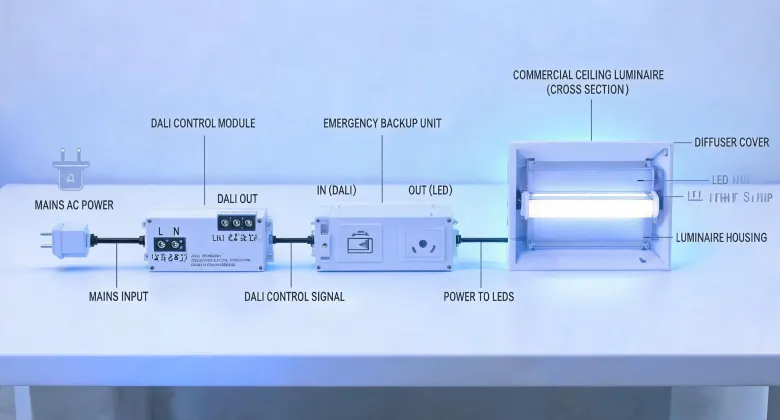
Emergency lights are a different animal. The LED source can be rated for 50,000 hours, but the battery is what fails. Most emergency light batteries—Nickel-Cadmium or Lithium Iron Phosphate—are rated for 4-5 years at 25°C ambient. In a hot ceiling plenum, that drops to 2-3 years.
The UL 924 certification (the US standard for emergency lighting) tests whether the fixture switches to battery power within 10 seconds of an outage and stays on for 90 minutes. It does not test whether the battery survives your specific environment.
I once told a vendor "verify the emergency light batteries." They heard "confirm the batteries are included in the box." Result: units shipped with batteries that had been sitting in a warehouse for 14 months—dead on arrival for a code-required installation. That communication failure cost us a weekend of emergency work and a $3,800 reshipment.
Should we have skipped the battery verification to hit the deadline? The upside was finishing on schedule. The risk was installing non-compliant fixtures in a building that needed a certificate of occupancy. I kept asking myself: is one week worth a failed inspection? We tested. Found the problem. Missed the deadline but kept the client.
How long do motion sensor lights last?
This is the question I get most often from facility managers. The honest answer: it depends on which part you're asking about.
- The LED source: 50,000 hours at L70 (70% of initial lumen output)
- The PIR motion sensor: rated in cycles, typically 10,000-20,000 operations
- The driver/power supply: 30,000-50,000 hours, but heat shortens that
- The battery (if wire-free): 1-2 years, replaceable in most designs
Here's the math. If a sensor activates 20 times a day, that's 7,300 cycles per year. At a 15,000-cycle rating, the sensor mechanism gives out around the 2-year mark. The LED is still fine. The sensor was the weak link all along.
So when a supplier claims a motion sensor light "lasts 50,000 hours," push back. Per FTC guidelines (ftc.gov), durability claims need to be truthful and not misleading. The LED package might hit 50,000 hours, but the fixture as a whole almost certainly won't. In my testing, a quality wired motion sensor downlight delivers 5-7 years of trouble-free operation in a typical commercial corridor. The fix at that point is replacing the sensor head, not the whole fixture—so spec a model with a replaceable sensor.
Even after I approved the motion sensor fixture model we'd selected for client projects, I kept second-guessing the detection angle. What if the corridor was wider than the sensor's 30° cone? Didn't relax until the first 20 installations all triggered within spec.
Dimension 3: Compliance—What Has to Be True on Paper
Certifications are where display and lighting products overlap only about 20%.
- Televisions: FCC Part 15 (emissions), UL 62368-1 (safety), Energy Star for TVs, California Title 20
- Lighting fixtures: UL 1598 (luminaires), UL 8750 (LED equipment), UL 924 (emergency lights), Energy Star for downlights, California Title 24, and DLC (DesignLights Consortium) for commercial projects
The practical impact: if you're specifying lighting for a commercial building and the fixture lacks the right certification, the electrical inspector will flag it. I've seen a contractor try to install non-certified emergency lights in a stairwell. The remedial work cost more than the cheap fixtures saved.
That's why my first question for any supplier isn't "how many lumens?" It's "can I see the UL report?"
Dimension 4: Spot Downlight vs Emergency Light vs Motion Sensor
If your project needs Samsung LED lighting, here's the decision framework I use every week:
- Spot downlight: for accent lighting, retail displays, architectural focal points. Check the beam angle first: 15°-30° for accent, 30°-60° for general wash. And demand CRI 90+ if you're lighting products where color accuracy affects sales.
- Emergency light: for code compliance in hallways, stairwells, exit paths. Buy UL 924 listed units only, and budget for battery replacement at year 3-4. Don't buy on price alone—I've tested budget emergency heads that produce less light on battery than their LED rating suggests.
- Motion sensor light: for walkways, warehouses, utility rooms. Wire them to a circuit where the sensor directly controls the load. And remember: a PIR sensor cannot see around corners. Detection range and mounting height matter more than lumen output in most installations.
Don't expect one fixture type to do all three jobs. A downlight with a motion sensor is not an emergency light. An emergency light is not an accent fixture. I'd rather work with a vendor who says "that's a different product category" than one who promises a universal solution. The vendor who told me "this isn't our specialty—here's who does it better" earned my trust for everything else.
So Which Should You Buy?
Different products, different specs, different certifications. Don't buy them the same way.
For a Samsung 4K Smart LED TV: focus on panel quality, smart features, and warranty. If it's for commercial display, verify the warranty actually covers commercial installation—residential warranties often don't. (Should mention: our commercial display installations have held up well, but we also spec a surge protector on every unit.)
For Samsung LED lighting: match the fixture type to the application, verify the certification marks, and prioritize replaceable components. A downlight with a replaceable driver and sensor head is better long-term value than a sealed unit that fails as a single piece.
And for motion sensor lights specifically: plan for 5-7 years of practical service life, spec a replaceable sensor head, and treat any "50,000 hours" claim as the LED rating, not the fixture rating.
One last honesty note: I've rejected Samsung LED lighting shipments too. Not because the brand is bad—because that specific batch had a spec deviation. That's what quality control is for. The brand name gets a product through the door. The spec sheet and the test data decide whether it stays.