I'll Say It Straight: "We Can Do Everything" Is a Red Flag
Six years ago, I took over lighting procurement for a hospitality company with 14 locations. We spend about $120,000 a year on lighting—ceiling downlights, under-cabinet fixtures, emergency lights, and more recently, smart lighting controls. I've gathered quotes from maybe 40 vendors and processed close to 150 orders since then. Every one of those orders is documented in our cost tracking system, which is why I can tell you with confidence: the supplier who promises "everything, all in one" is usually the one who does none of it well.
I'd rather work with a specialist who knows exactly what they're good at—and tells me when they're not the right fit—than a generalist who smiles and says yes to everything. That probably sounds like common sense. But in procurement, the one-stop-shop pitch is everywhere. One vendor, one invoice, one phone call. It's attractive. The problem? The hidden costs show up on the second invoice, not the first.
The Hidden Costs Show Up Later
Let me give you a real example. In Q2 2024, we needed 120 recessed ceiling downlights for a renovation. Vendor A—an LED specialist—quoted $25 per fixture, all-in. Vendor B, the "full-service" lighting supplier, quoted $18. I almost went with B. That's an $840 apparent saving on paper.
Then I ran the numbers the way I do with every order. Vendor B's quote didn't include dimmable drivers—that was $8 extra per fixture, or $960. They charged a $350 "smart system integration fee." Shipping was about $100 more. Total for Vendor B: $3,570. Vendor A: $3,000 even. The "cheap" option actually cost us $570 more. I caught it because I track every line item.
That experience became part of our procurement policy. We now require itemized quotes with line-level detail before any vendor goes into consideration. Vendor relationships matter more than vendor capabilities—it took me 3 years and about 150 orders to fully understand that. The "free setup" offer from another supplier cost us $450 in hidden configuration fees we didn't know about until the invoice arrived. On a separate project, the "budget" fixture choice failed inspection and we spent $1,200 on a redo. Those aren't horror stories. That's just what happens when the quoted price and the real price are two different numbers.
When we re-quoted the same specs in January 2025, commercial 4-inch downlights (3000K, dimmable) ranged from roughly $15 to $25 per unit at the budget end and $25 to $45 for mid-range fixtures with better drivers and longer warranties. The spread is normal. The issue is when a vendor quotes the low end and drops the rest into hidden fees. A specialist lays out the full picture before you commit.
It's About the Size, Not the Sale
If you've ever typed "what size under cabinet lighting do i need" into a search bar at 11pm, you know the drill. The simple answer: measure the cabinet run, divide by the fixture length, and plan for roughly 300–500 lumens per linear foot for task lighting. But the real questions are the ones nobody asks on a spec sheet.
How much clearance is there between the cabinet underside and the counter? Are the fixtures hardwired or plug-in? Is there a neutral wire available for smart controls? What color temperature suits the space—warm enough for a bar, cool enough for a prep kitchen? Get any of those wrong and you're not saving money. You're deferring it.
A generalist sold us a "standard kit" once. I say "standard" loosely—the fixtures were an inch too deep for the recess, left dark spots every three feet, and the light made sandwich prep look unappealing. We paid to redo it. The most frustrating part of vendor management: the same issues keep recurring even after you've spelled everything out. You'd think a written spec would prevent mismatches, but interpretation varies wildly by vendor.
The specialist who stepped in asked about mounting depth, counter height, and dimming setup before sending a quote. That's the difference between selling lights and solving a lighting problem.
The Smart Lighting Line Is Real
The surprise wasn't the price difference on that downlight order. It was how much hidden value came with the specialist's option—support, revisions, quality guarantees. That pattern repeated when we moved into smart lighting last year.
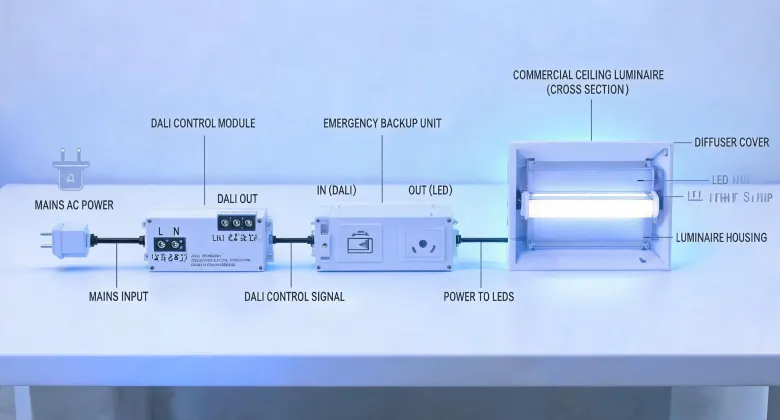
A smart lighting system is not a phone app with a color wheel. It's Zigbee compatibility, occupancy sensors, emergency lighting integration, and someone who can actually program the scenes. When a generalist says "we do smart lighting," they usually mean they'll sell you smart bulbs. When a specialist says it, they ask what you're integrating with and hand you a compatibility list before the first site visit.
And here's where I get a bit contrarian: consumer LED products are not the same as commercial lighting. Take Samsung as an example. My COO has one of those LED cases on his S22 Ultra and genuinely loves it. I ran a Samsung Odyssey G30D 24-inch LED monitor on my desk for a year—one of the best displays I've used, honestly. Both prove Samsung understands LED technology at a deep level. And when a vendor offers samsung-led fixtures, that engineering consistency is a real plus. But knowing how to build a bright gaming monitor doesn't automatically make someone the right choice for a ceiling downlight layout. The vendors who know where that boundary sits—the ones who say "this consumer product is for your desk, this commercial fixture is for your ceiling"—are the ones worth calling.
According to U.S. Department of Energy data from 2023, LEDs account for more than half of all lighting shipments nationwide. Most buyers are already sold on LED. The challenge isn't the technology anymore—it's applying it correctly. That's exactly where specialist knowledge earns its keep.
Sure, One Invoice Is Nice—Until It Isn't
I get the counterargument. Procurement teams are stretched. One vendor means one contract, one relationship, one point of contact. That's a real benefit. And to be fair, the generalist's sales rep was always quick to respond and happy to bundle everything into a single quote.
But the convenience evaporates fast when a "complete" package arrives missing dimming modules—and the vendor tells you those are a "separate item." We once waited three weeks for backordered parts while the generalist pointed fingers at their own sub-supplier. Specialists have smaller supply chains and clearer accountability. I'll take that over a single invoice any day.
Granted, my approach requires more upfront work. Our policy now requires at least three quotes for any order above $5,000. But since 2023, that discipline has trimmed roughly 17%—about $20,000 a year—off our lighting spend. That's not a rounding error.
Bottom Line: Do One Thing Well
After six years and about 150 orders, I'm confident in this: knowing what you're not good at is a feature, not a flaw.
In lighting, that means finding a partner who can spec the right ceiling downlight, the right under-cabinet size, and the right smart lighting system—without pretending to run your entire electrical infrastructure. Someone who tells you when to call an engineer instead of saying "we've got it covered."
The specialist who admits their lane earns my trust for everything else. That honesty has saved us more money than any "we can do it all" promise I've ever received. If a supplier ever tells you "this isn't our strength—here's who does it better," hold on to them. That's the most valuable sentence in vendor sales.