Who This Checklist Is For
If you're planning a commercial lighting or display upgrade and the words "Samsung LED" have come up in meetings—this is for you. Maybe you're outfitting a retail space, upgrading a conference room, or putting together a bid for a warehouse. I've done this dance about a dozen times over the past 6 years, managing a $180,000 annual procurement budget for lighting and AV equipment.
This checklist assumes you've already narrowed your options to Samsung LED (whether it's their downlights, spotlights, or a 65-inch display). What we're doing here is making sure you don't miss the costs that eat your budget after the quote. Six steps. Follow them in order.
Step 1: Get Past the Sticker Price
When I first started buying LED fixtures, I made the classic rookie mistake: I compared unit prices and went with the lower number. Turned out the "lower" quote didn't include the dimming drivers we needed. That was a $600 add-on I discovered after the PO was signed.
Here's what to ask upfront when you get a quote for Samsung LED products:
- Is this the product price or the installed price? Some quotes assume you're handling installation. Some don't.
- What's included in the base price? Drivers? Mounting brackets? Cables? For a Samsung LED 65 inch TV used as a digital signage display, the wall mount and media player are often separate line items.
- Are there minimum order quantities? For commercial LED downlights, MOQs can hit 50+ units. If you only need 20 for a small office, that changes your per-unit cost.
My rule of thumb: take the quoted price and add 15% for "stuff we forgot to ask about." I've been doing this long enough to know that's conservative.
Step 2: Match Specs to Your Actual Use Case
I almost ordered Samsung H5000F 32" HD LED Smart TVs for a hotel project. It's a solid TV. But then I realized we needed a commercial-grade display with a 24/7 warranty and a higher brightness rating. The H5000F is a consumer TV. It's not built to run 16 hours a day in a lobby.
This step is where most buyers trip up. They see "Samsung LED" and assume it's all the same. It's not. Here's what to check:
- For lighting: Is the spotlight small enough for your track? I've seen installs where the trim ring didn't fit the cutout. Measure twice.
- For displays: What's the operating hours rating? Consumer panels are typically rated for 8 hours/day. Commercial ones go 16-24 hours.
- For controls: If you're integrating with an existing Zigbee system, make sure the Samsung LED products are Zigbee-certified for that specific hub. We had a $2,500 compatibility mishap in Q2 2023 because I assumed all Zigbee devices played nice together.
Step 3: Don't Skip the Control System
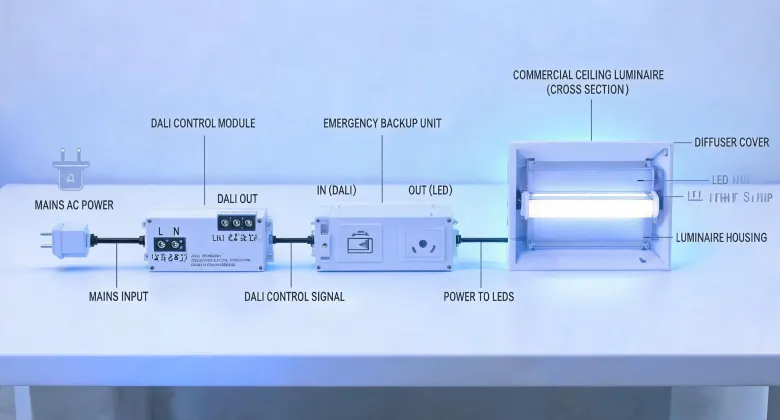
Here's something vendors won't tell you: the fixture is one cost. The control system is another. And 'works with motion sensors' doesn't tell you which motion sensor.
I lost count of how many times I've seen the phrase "motion sensor vs occupancy sensor" in specs. Here's the reality: they're not the same thing. A motion sensor detects movement. An occupancy sensor detects presence. If you're putting a spotlight small enough for a task area in a warehouse, you probably want occupancy sensing so the light stays on while someone's standing still. Big difference in energy code compliance and user satisfaction.
What to do on this step: Ask for the specific model numbers of the sensors and controllers included in the quote. Then look up their datasheets. Yes, it's tedious. I've done it for 8 projects and caught 3 mismatches that would have cost us later.
Step 4: Model the TCO Over 5 Years
I built a TCO spreadsheet after getting burned twice on so-called cheap options. Here's what I track:
- Initial product cost (the obvious one)
- Installation labor (takes longer for some fixtures than others)
- Energy consumption (based on actual wattage, not claimed equivalent)
- Replacement frequency (Samsung LED drivers are solid, but they do fail)
- Disposal costs (for large amounts, this adds up)
I ran the numbers on a recent bid comparing Samsung LED downlights against a lower-priced competitor. Samsung was 22% more upfront. But after 5 years of energy savings—their fixtures run about 15% more efficient—the total cost was within 3%. The reliability difference? That tipped it in Samsung's favor. We haven't had a single driver failure in 3 years across 200+ fixtures.
Step 5: Lock Down Delivery and Lead Times
This is the step I learned the hard way. In early 2024, I ordered 150 spotlights from a vendor who quoted a 4-week lead time. Week 3, I checked in. "Oh, the spotlight small model you ordered is backordered 6 more weeks." They didn't mention it. I had to find out.
Ask directly:
- "What's the current lead time for this specific SKU?" (not a generic answer)
- "Do you stock these or are they made to order?"
- "If I need 50 units of the Samsung LED 65 inch TV for a job, how many do you have in the warehouse vs. factory order?"
If you're working with a supplier who can't answer these in 10 minutes, consider that a red flag. I've switched vendors for fast, transparent answers.
Step 6: Verify Warranty and Support
Most people read the warranty page. Few people understand it. I almost got caught by a 'limited lifetime' warranty that actually meant '5 years for LEDs, 2 years for drivers, labor not included.'
For Samsung LED commercial products, here's what you want to confirm:
- Is it a parts-and-labor warranty, or parts only? Labor can be more expensive than the part on a commercial install.
- Who handles the claim? The manufacturer? The distributor? The installer? I had a case where all three pointed at each other for 6 weeks. That was a fun conversation with my CFO.
- What's the advance replacement policy? If a spotlight dies, do they ship a new one before you return the defective one, or after? That's a week of downtime difference.
Bottom line: get the warranty details in writing before you sign anything. Verbal promises don't get fixtures replaced.
Common Pitfalls to Avoid
- "It's all Samsung, so it'll work together." Not a safe assumption. A Samsung LED TV and a Samsung LED downlight are different products from different divisions. Don't assume a seamless ecosystem.
- "We'll figure out the controls later." We bought Zigbee-compatible fixtures first, then tried to integrate with a non-Zigbee system. Had to buy a $400 bridge. Do the controls research upfront.
- "The spec sheet says it's compatible." Spec sheets are written by marketing. I've found at least 3 instances where 'compatible' meant 'it won't catch fire, but we haven't actually tested it.' Ask for tested references.
Pricing note: All costs and lead times mentioned are based on my experience with quotes and orders from Q1 2023 through Q1 2025. Verify current rates with your supplier—things change fast in this industry.