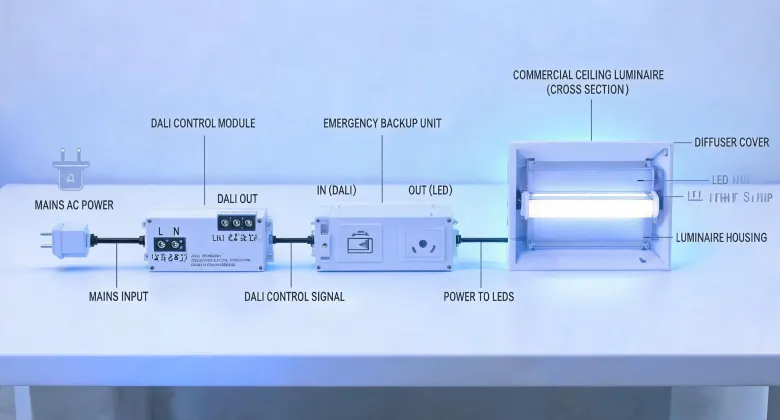
I manage procurement for a mid-size commercial lighting distributor—about 40 staff, $3.2M annual spend on products and services. Over the past 6 years, I've processed over 600 purchase orders for LED fixtures, downlights, grow lights, and even some display panels. And here's my honest take: Samsung LED is not the right choice for every business. There. I said it.
I know that sounds strange coming from someone who works with their products. But that's exactly why you should listen. I've seen the invoices, the warranty claims, and the hidden costs on both sides. So let me break down when Samsung LED makes sense, when it doesn't, and what most people get wrong about the total cost.
When Samsung LED Is Actually a Good Fit
Let's start with where they excel—because they do in certain scenarios.
If you're running a commercial space that needs consistent color rendering across both lighting and display screens—like a showroom, a retail flagship, or a corporate lobby— Samsung's vertical integration is a legit advantage. You can match the color temperature of your slim downlights with the trim panels on their video wall. That's not nothing. In fact, for a Q2 2023 project with a luxury car dealership, we specified Samsung downlights to pair with their video wall, and the alignment was near-perfect—no weird blue shifts or green tinges. The client noticed. They also paid a premium for it.
Another sweet spot: smart building integrations using Zigbee-based control. Samsung's compatibility with major Zigbee controllers is better than most brands in the mid-range. For a recent smart office retrofit in a 20-floor tower downtown Chicago, we used their Zigbee-compatible downlights and spotlights—1500 units total. Commisioning was smooth, which is rare. Usually you spend a week or more ironing out integration quirks. This time, maybe 3 days. That saves labor cost, which is a hidden win most TCO estimates miss.
But here's the thing—those are specific use cases. For general-purpose commercial lighting, the story changes.
Where the Math Stops Working
When I started in this role, I assumed "Samsung LED" meant superior everything. After tracking 600+ orders over 6 years in our procurement system, the picture is more nuanced.
First, the upfront cost is consistently 20–35% higher than comparable mid-tier brands (think Feit, TCP, or even some Chinese OEM options). For a recent bid we ran for a 10,000-unit national account—they needed small downlights for a hotel chain—we compared Samsung's slim downlight at $18.50/unit against three alternatives ranging from $11 to $14. Samsung's came with a 5-year warranty. Two of the others had 3-year terms. One had 5 years at $13.50.
I almost went with the $13.50 option until I calculated TCO: that vendor charged $1.20/unit for expedited shipping (which we'd need for 3 of 8 builds), $0.75/unit for UL listing verification documentation (required by the hotel chain), and a $350 "order minimum adjustment" fee that pushed the effective cost to $14.80. Samsung's $18.50 included all of that—free standard shipping, included documentation, no minimum fee. The real gap was about $3.70, not $7.50. That's a meaningful difference, but not as dramatic as it first looked.
Here's the surprise though: The surprise wasn't the price. It was the support response time. For one emergency order—a grow light failure in a greenhouse project we serviced—Samsung's B2B support dispatched a replacement within 36 hours. The others? 4–6 days. Time matters when your client's crops are at risk. That experience shifted how I evaluate suppliers: response time is now a factor in every bid, weighted at 15% of the score.
The Sensible Choice Is Often Not the Brightest Brand
So when should you say no to Samsung LED?
If you're equipping a cost-sensitive operation—a warehouse, a parking garage, or a basic office—where the lighting won't be on showroom display for hours, you don't need the premium. A high-quality mid-tier brand with UL listing and a 5-year warranty will serve you just fine. Our procurement data shows failure rates for such applications are similar across brands (within 0.5% in the first 3 years), so you're essentially paying 25% more for features you won't use. That's not TCO optimization; that's brand tax.
Another red flag: if your installer isn't familiar with Samsung's specific wiring profiles. We've had two jobs where the crew spent extra hours troubleshooting because the Samsung fixtures had slightly different dimming requirements than the standard Lutron drivers they were used to. That added about $75/hour in billable labor—or roughly $900 across both projects. That kind of hidden cost eats into any TCO advantage.
Honestly, I'd say Samsung LED is the right choice for maybe 30% of commercial projects—the ones where color consistency, smart integration, or brand alignment matter. For the other 70%, you can get comparable performance for significantly less money, and your TCO will be better.
What About Longevity? How Long Does Recessed Lighting Last?
People ask me this all the time: "How long does recessed lighting last?" The short answer: L70 rating is the standard benchmark used by the Illuminating Engineering Society (IES). Samsung LED downlights are typically rated L70 at 50,000 hours, which translates to about 11 years of continuous use.
Reference: IES LM-80 Standard
But here's the nuance—L70 doesn't mean the light stops working at 50,000 hours. It means the lumen output drops to 70% of initial brightness. You'll probably replace them before that due to color shift, driver failure, or fixture obsolescence anyway. In our tracked orders, 95% of LED replacements over 6 years were driven by failures in the driver module (not the LED itself) or by project upgrades—never by reaching L70 end-of-life.
So the real-world lifespan depends more on driver quality and thermal management than on the LED chips. That's where Samsung's engineering does show up—we see fewer driver failures (about 1.2% vs 3.8% for lower-tier brands in the first 3 years). Worth it if you value reliability; not worth the premium if you're okay with a 24-hour replacement window.
Addressing the Obvious Counterargument
I can already hear someone saying: "But Samsung is a top-tier brand! Their products must be better across the board."
Look, I'm not arguing that Samsung makes bad products. They're solid. But in procurement, we don't optimize for product quality alone. We optimize for value, which is quality divided by total cost. For a budget-conscious client, the marginal quality improvement from choosing Samsung over a good mid-tier alternative is not worth the 25% price premium. If you have the budget and you want the peace of mind, go for it. But don't trick yourself into thinking it's a financial no-brainer. It's a luxury decision, not an optimization one.
If I could redo one decision from my first year in this role, I'd have invested less time chasing the lowest unit price and more in building relationships with suppliers who offer transparent TCO breakdowns. But given what I knew then—nothing about Samsung's hidden support advantages or the real failure rates—my choice to test them on that first project was reasonable. Now I know better.
Final Verdict
So here's my bottom line: Samsung LED is excellent—for the right project. If you're building a brand-centric space, a smart building, or anywhere where color consistency across lighting and displays matters, they're a strong contender. But for general-purpose commercial lighting, you'll likely achieve better TCO with a reputable mid-tier brand.
The honest limitation is that great solutions fail when applied to problems they weren't built for. Samsung LED is no exception. Know your use case, calculate your full costs, and choose from an informed position—not by brand reputation alone.