-
Step 1: Map the Space Before You Look at Fixtures
-
Step 2: Learn the Three Specs That Actually Matter
-
Step 3: Decide on Smart Controls Before You're Locked In
-
Step 4: Match Product Family to the Job
-
Step 5: Compare Quotes on Lead Time, Not Just Price
-
Step 6: Verify Warranty, Returns, and Support Before You Sign
-
Step 7: Test a Sample Batch Before You Commit
-
Common Mistakes to Avoid
When I took over purchasing for our company's offices in 2022, lighting was the last thing on my priority list. The previous procurement manager left me a binder of past invoices and one piece of advice: "Get model numbers, not just promises." Six months later, after roughly $14,000 in lighting and display orders and one embarrassing video wall miscalculation, I understood what she meant.
If you're an office administrator, facilities coordinator, or operations person who suddenly owns lighting decisions, this checklist is for you. It's seven steps, in the order I do them, refined over about 200 orders and five years of managing this category. It's not an engineering guide—for complex projects, hire a lighting designer. But it will keep you from making the expensive mistakes.
One caveat: my experience is based on mid-range commercial office installations. If you're outfitting a hospital, a luxury retail space, or an industrial workshop, your specs and process will differ. I can't speak to those segments.
Step 1: Map the Space Before You Look at Fixtures
I start with a spreadsheet and a slow walkthrough of every room. Each room gets a row with three columns:
- Function: Meeting room, open office, break room, lobby, exterior path, warehouse
- Task: Reading, video conferencing, product inspection, security, wayfinding
- Atmosphere: Corporate, collaborative, customer-facing, utility
What I mean by this: you can't pick a fixture from a catalog photo because the photo doesn't tell you what job the light needs to do. A video conference room needs vertical light on faces—roughly 300 lux at eye level—without glare into the camera. A loading dock needs flood lights with motion sensing and weatherproofing. Those are completely different problems.
Skip this step and you end up with nice-looking fixtures that leave the room feeling dim. I have table lamps in the executive conference room—functional, not aesthetic—because the ceiling downlights alone don't come close to what a camera-facing meeting needs.
Step 2: Learn the Three Specs That Actually Matter
Lumens, CRI, and color temperature. Those three numbers tell you most of what you need to evaluate a Samsung LED fixture or any other manufacturer's offering.
Lumens are brightness. Not wattage. A 15-watt fixture can produce 1,500 lumens, and so can a 25-watt one—if you buy on wattage, you're guessing.
CRI (Color Rendering Index) measures color accuracy on a 0–100 scale. Office-standard practice: 80+ is acceptable. 90+ is better for meeting rooms, lobbies, and anywhere you're reviewing printed materials, product samples, or Pantone colors. If you're doing color-critical work in-house, low-CRI fixtures will shift how those colors look—plain and simple.
Color temperature sets the mood: 3000K warm and relaxed, 4000K neutral, 5000K clinical. I order 4000K for workspaces, 3000K for reception and break areas, and 5000K for storage and loading. Every supplier should list these three specs on the datasheet. If they don't, walk away—we saw one quote from a budget vendor that described fixtures as "high-quality LED, ultra energy efficient" without a single number. That's not a spec sheet.
Also, look for DLC (DesignLights Consortium) or Energy Star listings on commercial fixtures. They're not guarantees, but they're a useful baseline check for quality drivers and honest performance claims.
Step 3: Decide on Smart Controls Before You're Locked In
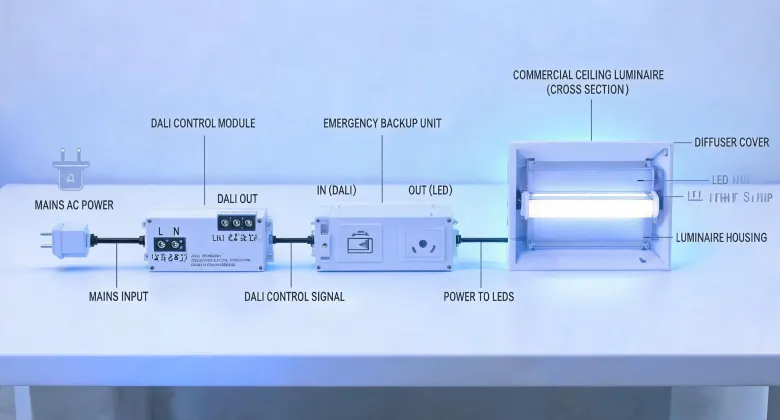
If you think you might want smart lighting—schedules, occupancy sensing, Zigbee integration—make that call before you finalize fixtures. Retrofit is painful.
Samsung's SmartThings ecosystem supports Zigbee 3.0, which is a common protocol across lighting brands. Standardizing on one protocol matters because switching later means replacing drivers and hubs, not just apps.
Our operations director asked for "lights that dim when people leave." We went with Zigbee-compatible drivers and a small hub. The energy savings landed somewhere around 15%—I might be misremembering the exact figure, but the automation paid for itself in under a year. That only worked because we decided on the protocol early.
Step 4: Match Product Family to the Job
This is where the categories come in, and where a lot of first-time buyers get lost.
Downlights are the workhorse for general office lighting. Even distribution, decent glare control, easy to specify once you know your CRI and color temperature.
Spotlights are accent lighting—artwork, feature walls, display cases. We once ordered a spotlight model that had won a Spotlight Award at a trade show. It won the award on paper. In our ceiling, it produced a hot spot in the middle and a dim ring around the edges. Nothing wrong with the product per se; it just didn't suit our beam angle needs. Test samples before you scale.
Flood lights go outside—parking lots, signage, loading docks, security perimeters. They must be IP-rated for weather. Our first batch of parking lot flood lights had roughly a 20% failure rate within six months due to water ingress. The replacement line has been clean so far. Small sample, but it made me never want the absolute cheapest exterior unit again.
Emergency lights are a code compliance item, not a design choice. Check battery testing requirements and make sure your installer knows the local code.
Grow lights: if someone in the office decides to turn a conference room corner into a plant wall—someone always does—you'll hear the question: what light do plants grow best under? The honest answer for most office plants (pothos, snake plants, monstera) is that they don't need dedicated grow lights at all. A nearby 4000K downlight is usually sufficient. Full-spectrum LED grow lights matter for light-hungry plants or spaces with no natural light; red and blue wavelengths drive photosynthesis. But don't overspend unless you have a serious plant collection.
Samsung LED displays: in B2B procurement, this comes up in the same conversation as lighting because both are "things that plug in and hang on a wall." For meeting rooms, the Samsung 4K UHD LED smart TV line is the default. I spent several evenings reading smart tv samsung 4k ultra hd led reviews before ordering two 65" units; the reviews consistently said the mid-range models handle presentations well and the premium margin isn't worth it for occasional internal use.
For larger lobby or showroom walls, the Samsung Onyx Cinema LED is a different beast entirely—a direct-view LED wall with real blacks and HDR that works in bright spaces. The price is project-based. We once got a ballpark quote for a 10-foot-wide configuration: roughly $120K installed, including the video processor. Don't quote me on that; I might be misremembering because it was bundled into a larger AV proposal. Get your own quotes.
Step 5: Compare Quotes on Lead Time, Not Just Price
In March 2024, we paid $400 extra for rush delivery on a custom-length LED track system. The alternative was missing a $15,000 product launch event. The vendor guaranteed a date and shipped on time. A cheaper quote with "probably two weeks" would have put the entire event at risk.
Probably on time has a hidden cost. You just don't see it until the event date passes.
When comparing quotes, put three things side by side:
- Delivery date in writing, not "estimated"
- What happens if the date slips—credit, discount, partial rush shipment?
- Who bears the shipping risk
People think rush fees exist because vendors know you're desperate and want to gouge. Actually, rush fees reflect real costs: they disrupt planned production schedules, require priority handling, and shift risk to the vendor. The fee buys certainty, and certainty has enough value that we now budget for it in critical projects.
Step 6: Verify Warranty, Returns, and Support Before You Sign
Ask these questions every time:
- Who answers when a fixture flickers or a display shows a dead pixel?
- Is the warranty prorated? A "five-year" warranty with a pro-rating clause is materially weaker in year four than it sounds.
- What's the restocking fee on a wrong order? We ate a 20% restocking fee on 30 downlights ordered with the wrong color temperature. Actually, the department budget ate it. Finance did not share my gratitude.
For Samsung LED displays, commercial warranties cover panel defects, but verify whether dead pixels and burn-in are included, and whether service is on-site or mail-in. We had a 65" display with uneven backlighting in corners; the exchange was painless because we caught it within the first 30 days.
Step 7: Test a Sample Batch Before You Commit
Order one or two units of each fixture type before the full batch. Check:
- Color consistency across identical units—LED binning can cause slight differences
- Flicker at different dim levels; use your phone's slow-mo camera
- Audible hum from the driver
- How the beam actually lands on your wall and ceiling with your trim and ceiling color
This step has saved our install from a bad batch at least twice. It's a small cost compared to the alternative: 50 fixtures installed, four of them wrong, and a contractor bill to remove and reinstall.
Common Mistakes to Avoid
The cheapest-bid trap. The lowest quote sometimes genuinely works for back offices and storage rooms. But for lighting people work under every day, a $15-per-fixture difference is often invisible in the budget and very visible in the room. I get why budgets push to the low bid—we've all been there. Set a quality floor before inviting price competition, and let vendors compete above it.
The "all LED is the same" assumption. That thinking comes from an era when LED was new, the market was limited, and a "LED" label implied a certain baseline. Today, two downlights with the same lumen rating can differ by 30–40% in efficiency, lifespan, and flicker. The difference is in the LED chip, driver quality, and thermal management. That's a good reason to work with a brand that publishes real engineering data and stands behind it.
Forgetting the cost of installation. Fixtures are maybe half the total project. Installation, mounting hardware, controls, disposal, and contractor markup add up. Sometimes a better fixture at a higher unit price still installs for less, because it needs less labor. Compare installed cost, not sticker price.
Underestimating lead time. Delivery uncertainty compounds. Your contractor schedules around it, stakeholders schedule around it, and a missed date sends ripples. In B2B buying, a written delivery date is worth far more than a vague promise.
That's the checklist. Start at step one and work through in order. If you're already mid-project, at least do steps six and seven before the final order. And if your purchasing experience turns out differently than mine—if you're buying for a very different kind of space or scale—adapt accordingly.