Here's the short version: your budget doesn't blow up on unit price. It blows up on substitutions that don't fit, missing accessories that stall installation, and freight charges that appear after the PO is signed. Across roughly 700 orders I've handled over six years, unit price was the deciding factor maybe ten times. Everything else traced back to those three things.
I run procurement for a mid-size electrical contractor. About $600K a year, split between fixtures and controls. I'm not going to pretend that makes me an expert on every market—but it's enough experience to know which "savings" are real and which ones just push the cost downstream.
Let me be specific, because "be careful" is useless advice.
Cooper Lighting and the brands underneath it
Cooper Lighting has been part of Signify since 2020. Before that it was a standalone manufacturer with a decent stable of brands: Halo for residential, Metalux for commercial, Lumark for outdoor. The headquarters sit in Peachtree City, Georgia, and the sub-brands have kept their own identities even after the acquisition.
If you've searched "APEL Cooper Lighting," you're probably looking at a distributor's project inventory or a regional catalog reference—not something on the manufacturer's own site. That's not me guessing; it's just how regional references tend to show up. Verify it against the distributor's actual documents before it goes into any cost model.
Everything I'd read about brand-name fixtures said the pricing premium would kill the budget. For our order sizes, that wasn't true. On a high bay order last year, we compared Metalux against two alternatives. The Metalux quote came in about 4% higher per unit—but the lead time was nine days shorter, and the distributor offered same-day tech support. Nine days on a warehouse retrofit, at our crew cost, was worth more than the 4% gap.
That's the reverse of the usual "cheaper wins" logic. It held for us because the schedule was tight. On a project with more float, the math could flip.
High bay: where the real number hides
High bays are what warehouses, gyms, and factories use when the ceiling runs 20 feet or higher. Typical candidates are 100W-300W LED units replacing 400W metal halide or high-pressure sodium fixtures.
From the outside, the quote comparison looks simple: wattage, lumens, price. The reality is that about half the cost comes from things that aren't on the fixture spec sheet at all.
Here's a real one. We budgeted to swap out high bays in a 40,000 square foot warehouse. The lowest quote came in well below the other two. What wasn't in the quote: the mounting chains (another $8 or so per unit), a new circuit because the existing one couldn't handle the inrush, and the fixtures weren't DLC-listed—which killed the utility rebate. We caught it because I always ask "what's not included" before "what's the price."
Wait, I should correct that—"always" is too strong. I started asking that question after a $2,100 mistake on a different project. Before that, I compared prices like everyone else.
The other piece people miss on high bays: photometric layout. A 150W fixture at the wrong beam angle can leave aisles dim and force you to add fixtures you didn't budget for. The free lighting layout services that most distributors offer are not a courtesy—they're the difference between a quote that fits and one that doesn't.
One caveat: I've only run procurement for a mid-size contractor. If you're a national account, your leverage on pricing looks nothing like mine. If you're a one-truck operation, your supplier relationships carry more weight than your unit price.
Flood light and "light flood"
Flood lights—sometimes typed as "light flood" in searches—sit in the same category of "looks simple, isn't." Parking lots, loading docks, building exteriors. The number that matters is delivered lumens at the target surface, not raw lumen output on the box.
A 100W flood at 120° beam and a 100W flood at 60° beam can both claim 10,000 lumens, but they light very different areas. Ask for the photometric file. If the distributor can't send one, that tells you something about how much support you'll get after the sale.
The hidden cost here is usually mounting and aiming. A wall-mount bracket that isn't included, an aiming angle that needs a lift rental for a day, a photocell that wasn't on the PO. I've watched a $180 flood light turn into a $420 installed cost because nobody confirmed the accessories.
They delivered on time. (Should mention: we'd built in a three-day buffer, which we needed because the truck showed up late anyway.)
Can a normal light bulb grow plants? (Yes, but)
This question shows up in the strangest places, and it's tangentially relevant to what we do. Short answer: yes, a standard incandescent or LED lamp will grow plants, but it's an inefficient way to do it.
Incandescent bulbs emit a lot of heat and little usable light in the red/blue range plants actually use for photosynthesis. Regular white LED lamps are better, but their spectrum is optimized for human vision, not chlorophyll. Plants want specific wavelengths—roughly 400-500 nm (blue) and 600-700 nm (red).
The cost logic is the same as in commercial lighting. You can use a cheap product for the wrong job and it "works," but the total cost of running it is higher. For a real grow application, a dedicated plant LED (or whatever spectrum matches the crop) will usually pay for itself faster than a borrowed bulb from the garage.
Bottom line: yes, it works. No, it's not the answer you want if the goal is decent growth or energy efficiency.
Where this advice stops working
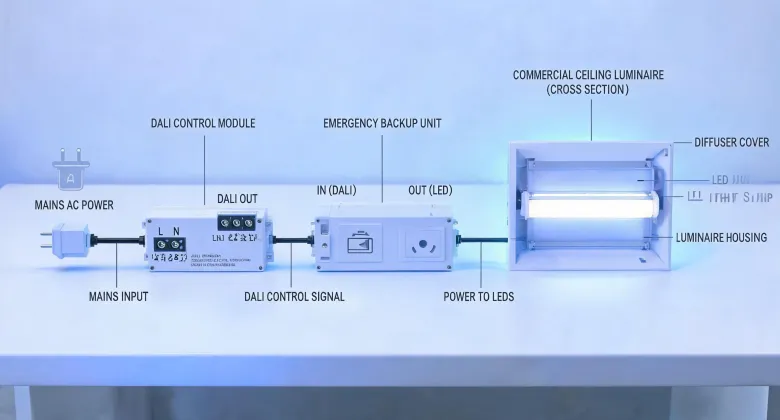
I haven't touched controls here, and that's where a lot of the real cost lives now—sensors, networked lighting, and the commissioning time none of the quotes include. That's a different article.
One thing I'll stand behind regardless of scale: the cheapest quote and the cheapest project are rarely the same thing. The vendor who shows you the extras up front, even if the total looks higher, is usually the one that costs less by the time the job closes out.